

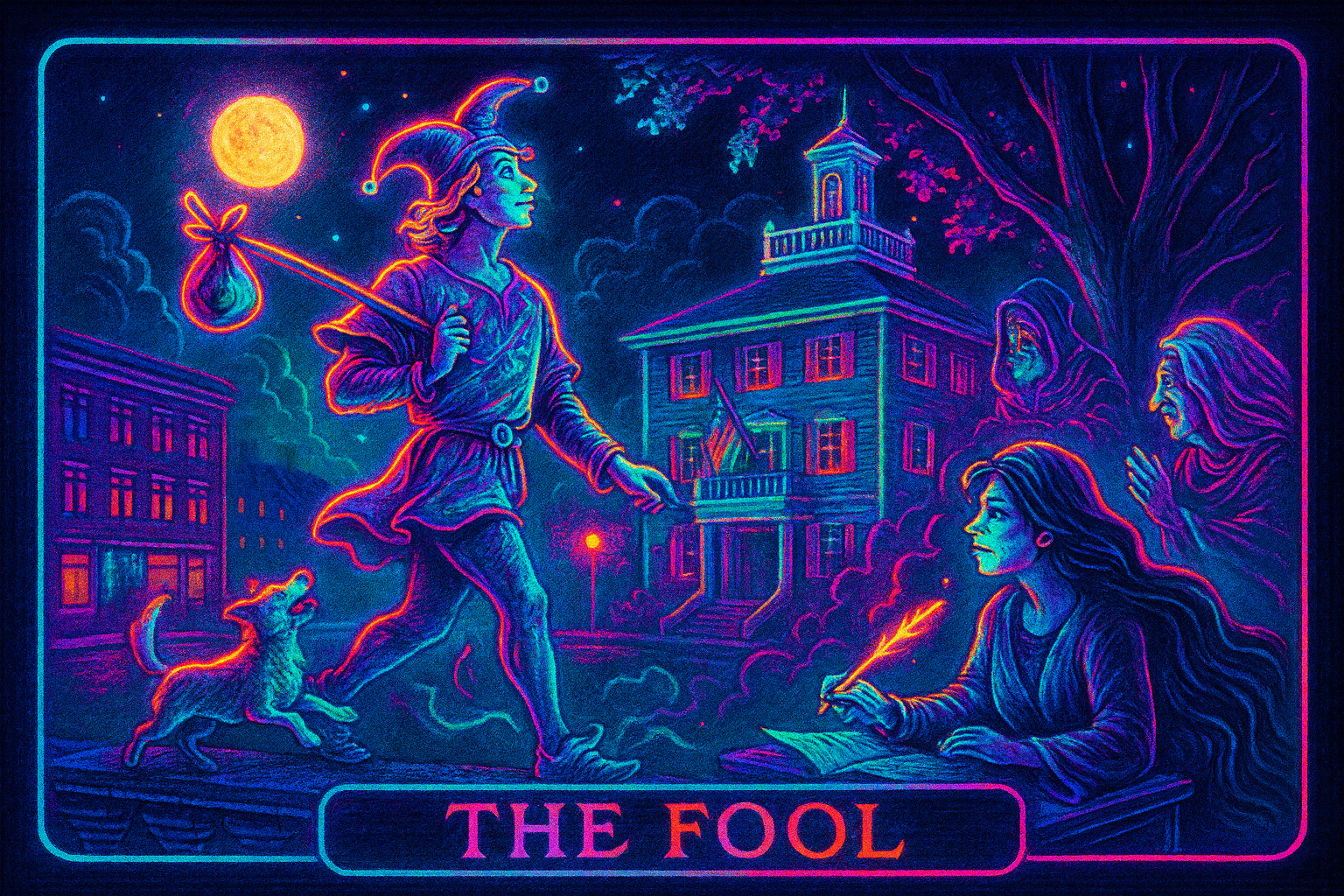
America’s first eccentric millionaire—proof that chaos and capitalism make excellent bedfellows.
“Ime the First Lord in the Younited States of A mericary”
That’s not a typo. That’s how Timothy Dexter (1747-1806) actually wrote—barely literate, magnificently spelling words however he damn well pleased, declaring himself a lord because “It is the voise of the people and I cant Help it and so Let it goue.”
Timothy Dexter was born poor, married money, accidentally became a millionaire, staged his own funeral to see who would mourn him, beat his wife for not crying enough, built a mansion covered in 40 wooden statues of famous men (including himself), declared himself “the greatest philosopher in the known world,” wrote a book with zero punctuation, and died wealthy despite doing everything wrong.
His book was a bestseller. Twice.
He is my spiritual ancestor in chaos.

The Improbable Fortune
Dexter dropped out of school at age 8 to work on a farm. At 16, he became a tanner’s apprentice. By his early 20s, he’d married a well-to-do widow and used her money to open a leather shop in Newburyport, Massachusetts.
But leather wasn’t where the fortune happened. The fortune happened because Dexter’s business rivals kept giving him terrible advice, hoping to bankrupt him—and he kept accidentally making money.
Bed Warmers to the Caribbean
Someone told Dexter (as a joke) to ship bed warmers to the West Indies. You know, those metal pans you heat up to warm beds in cold New England winters. To the tropical Caribbean.
Dexter bought 42,000 bed warmers and shipped them off.
When he arrived and found no market for bed warmers in the tropics, he rebranded them as molasses ladles and sold them to sugar plantations at a massive markup.
Coal to Newcastle
The phrase “selling coal to Newcastle” literally means attempting something absurdly pointless—Newcastle, England had its own massive coal mines and was the coal capital of Britain.
So naturally, someone told Dexter to ship coal to Newcastle.
He did.
His ships arrived during a coal miners’ strike. The city was desperate for fuel. He sold his entire cargo at premium prices.
Mittens, Cats, and Bibles
- Wool mittens to the West Indies? Asian merchants bought them for export to Siberia.
- Stray cats to the Caribbean? The islands desperately needed pest control. Profit.
- Bibles to the East Indies? Missionaries snapped them up. More profit.
Every single scheme that should have bankrupted him made him richer.
The Mansion of Madness

With his fortune, Dexter bought a mansion in Newburyport from local socialite Nathaniel Tracy. Then he decorated it like a fever dream:
- Minarets on the roof
- A golden eagle atop the cupola
- 40 wooden statues of famous figures: George Washington, Thomas Jefferson, Napoleon Bonaparte, William Pitt, Adam and Eve, Louis XVI
- Two statues of himself, one with the inscription: “I am the first in the East, the first in the West, and the greatest philosopher in the Western World.”
- He didn’t just have these statues; he often played musical statues, moving the statues around the various pedestals. Was this performative narcissism merely an act of grand satire if the grand figures of history and himself were often rotated around as if name and face connections were of no consequence?
- A mausoleum for himself in the garden
He also bought an estate in Chester, New Hampshire, and insisted people call him the Earl of Chester. Children who called him “Lord Dexter” got a quarter. Adults who did got dinner and drinks.
He was buying his own legend with spare change and liquor.
The Fake Funeral
At some point, Dexter decided he wanted to see who would mourn his death.
So he staged his own funeral.
3,000 people showed up.
The ruse was maintained until Dexter—watching from hiding—decided his wife wasn’t crying hard enough. So he came out and beat her for insufficient mourning.
Because nothing says “I love being dead” like domestic violence over fake grief.
A Pickle for the Knowing Ones
In 1802, Dexter published a short book called A Pickle for the Knowing Ones; or, Plain Truths in a Homespun Dress.
The book contained:
- Bragging about his accomplishments
- Complaints against his wife and others
- Zero punctuation
- Numerous misspellings
- Random capitalization
Example opening line: “Ime the first Lord in the younited States of A mericary, Now of Newburyport. It is the voise of the people and I cant Help it and so Let it goue.”
People complained about the lack of punctuation.
So Dexter added a page in the second edition with 11 lines of periods, commas, question marks, and exclamation points, with instructions: “thay may peper and solt it as they plese.”
Readers could insert punctuation wherever they wanted—or not at all.
The book went through eight printings.
A Pickle for the Knowing Ones is linked at the bottom of this page and can be easily found online.
The Poet Laureate
Dexter hired his own “Poet Laureate”—Jonathan Plummer, a fish peddler, street preacher, and amateur poet who praised Dexter in verse:
“Lord Dexter is a man of fame;
Most celebrated is his name;
More precious far than gold that’s pure,
Lord Dexter shines forevermore.”
Plummer was paid a small stipend to wander Newburyport reciting odes to Dexter’s greatness while selling spectacles, scissors, thimbles, combs, needles, and his own printed verses from a basket.
Dexter essentially hired a hype man before hip-hop existed.
(More on Plummer’s own magnificent weirdness in his dedicated post—including his claims about prophetic dreams and his “science of dreaming.”)
The Ghost Wife
Despite his fortune, Dexter’s relationship with his family was terrible.
He frequently told visitors that his wife had died, and that the woman living in the house was just her ghost.
His wife was alive. She was standing right there. He just decided she was dead and introduced her as a ghost.
This is either profound philosophical commentary on the death of affection or just peak asshole behavior. Possibly both.
The Death
Timothy Dexter died on October 23, 1806, at age 59. His obituary called him “one of the most eccentric men of his time” and noted that his “intellectual endowments” were not “of the most exalted stamp.”
Translation: They called him a rich idiot.
He left money for the care of Newburyport’s poor, which suggests that underneath the chaos, there was some shred of decency. Or maybe he just wanted people to remember him kindly.
His estate was valued at $35,027.39 (roughly $783,000 in 2023 dollars).
After his death:
- His household furniture and gilt balls were auctioned off on May 12, 1807
- The Great September Gale of 1815 toppled most of his statues
- The survivors were sold at auction
- Some were burned for firewood
- His mansion became a hotel, then passed through various owners
- In 1988, painters accidentally set it on fire with a blowtorch while removing paint
- The Society for the Preservation of New England Architecture had the original blueprints and rebuilt it exactly as it was
- The house remains a private residence today
Even his physical legacy couldn’t help but burn down and require resurrection.
Why This Matters
Timothy Dexter succeeded at everything he shouldn’t have. Every terrible decision turned into profit. Every absurd scheme worked out.
Was he lucky? Was he shrewd? Was he a chaos magician who understood that confidence and audacity create their own reality?
Yes.
Novelist John P. Marquand, who wrote two books about Dexter, noted that Dexter “was quiet and industrious for many years after his arrival in Newburyport, and not conspicuous until he suddenly made a fortune.”
Translation: Dexter was boring and sober until money gave him permission to be magnificently weird and publicly drunk.
The real lesson of Lord Timothy Dexter isn’t about business acumen or luck. It’s about what happens when someone refuses to let society’s contempt stop them from being exactly who they are—ridiculous, grandiose, barely literate, and absolutely committed to their own mythology.
He bought statues of himself and put them in his yard next to George Washington.
He wrote a book without punctuation and told readers to add it themselves.
He sold bed warmers in the tropics and made a fortune.
He staged his own funeral and beat his wife for not crying enough.
He was America’s first eccentric millionaire, and he did it all wrong, and it worked anyway.
The Dead Lucky Connection
I live just down the road from Newburyport. Lord Timothy Dexter’s mansion still stands on High Street, though these days it blends in with the other Federal-era homes: respectable, symmetrical, almost quiet. A passerby would never guess it once presided over one of the strangest domestic landscapes in early America.
Back in Dexter’s day, the grounds were a spectacle—a sprawling arrangement of statues, inscriptions, lions, political figures, classical heroes, and Dexter himself looming over the street. The house wasn’t absurd; Dexter’s use of it was. The building was the stage. He was the chaos.
What’s odd is how Dexter kept showing up in my life long before I knew enough history to clock the pattern. I spent years in and around Malden, roaming the area where his birthplace once stood. From 2006-2007, I lived briefly in Derry, NH to attend Chester College—just down the road from where Dexter declared himself Earl of Chester. Apparently the man’s geography and mine kept crossing paths before I had the language to explain why it felt familiar—this Dexter-trickster-chaos energy.
And as someone who’s built a career on being magnificently weird, barely credentialed, and absolutely committed to my own mythology despite society’s contempt?
Yeah. I see the lineage.
Dexter proved that chaos and capitalism make excellent bedfellows. That terrible advice can become brilliant moves if you’re stubborn (or lucky) enough. That you don’t need to be smart or educated to be rich—you just need to be relentlessly yourself and refuse to quit.
Unfortunately, he also proved that you can be a domestic abuser and still get celebrated in history, which is less inspiring and more a reminder of how wealth scrubs a lot of ugliness out of the record. It’s also a point about cycles and how they repeat. Dexter’s daughter-in-law later filed for divorce from his son on grounds of abuse—rare for the time, and telling.
Just as Giles Corey gets remembered for his dramatic refusal to plead while his very public abuse of his wife gets pushed to the margins, it changes the person in the story but not the story itself. Human beings can be brilliant and terrible at the same time. That contradiction isn’t an outlier—it’s the pattern.
But the core truth remains: Timothy Dexter shouldn’t have worked. And yet he did.
Just like selling coal to Newcastle shouldn’t work. But it did.
Just like writing a book with no punctuation shouldn’t succeed. But it did.
Just like being Dead Lucky shouldn’t be a viable life strategy. And yet here we are.
Sources:
- A Pickle for the Knowing Ones; or, Plain Truths in a Homespun Dress by Timothy Dexter (1802)
- Lord Timothy Dexter of Newburyport, Massachusetts by John P. Marquand (1925)
- Timothy Dexter Revisited by John P. Marquand
- The Life of Lord Timothy Dexter by Samuel L. Knapp (1858)
- Wikipedia: Timothy Dexter
- New England Historical Society: “Timothy Dexter, the Ridiculous Millionaire Who Sold Coals to Newcastle”
- Britannica: Timothy Dexter
- All That’s Interesting: “Timothy Dexter, The Most Eccentric Man Of Colonial America”
Related:

—Lord Timothy Dexter, on punctuation and life
A Pickle for the Knowing Ones
Author

Discover more from X|DEADLUCKY|X
Subscribe to get the latest posts sent to your email.