

Or: Learning To Tell Past/Present/Future Apart Before They Fuck You Up
You know how sometimes you’re reacting to something that hasn’t happened yet?
Or freaking out about something that happened 20 years ago like it’s happening now?
Or convinced you’re in danger when you’re objectively safe?
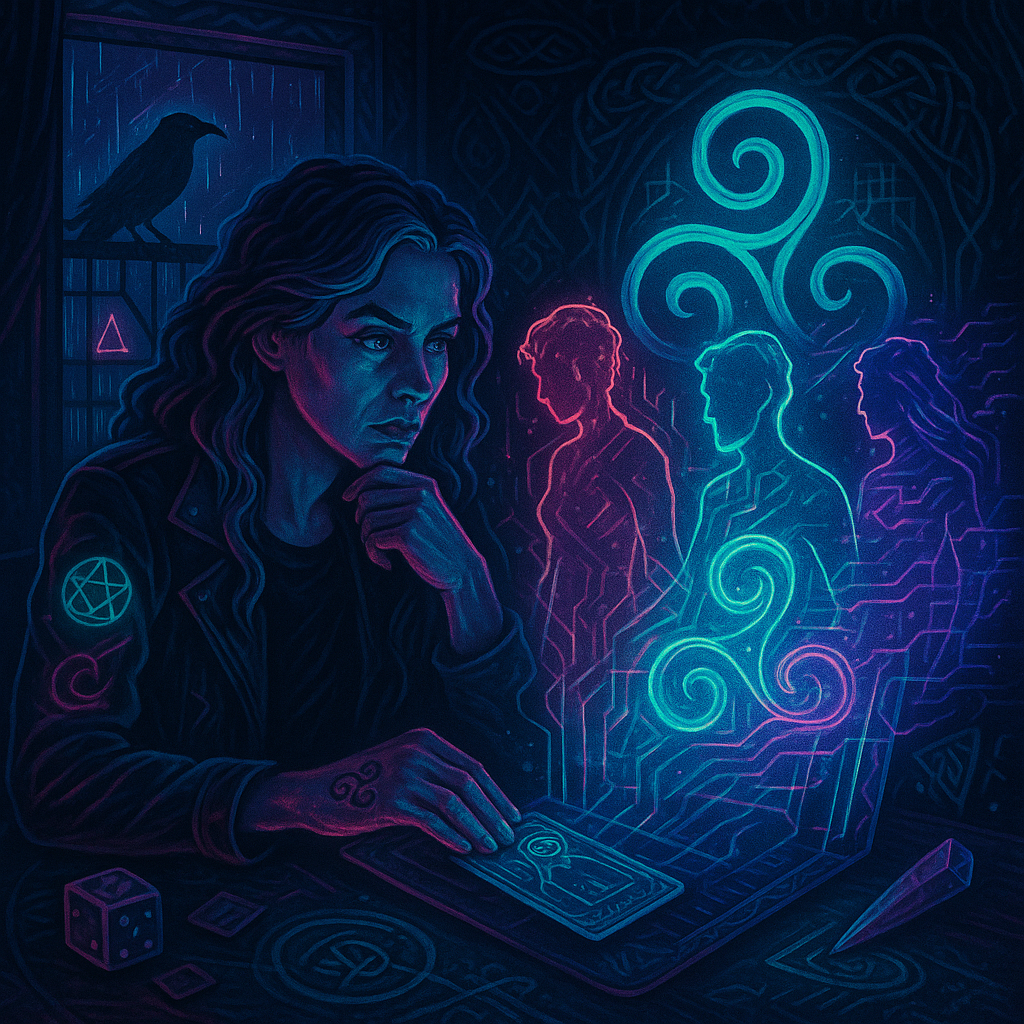
That’s because you’re processing three temporal streams simultaneously and can’t distinguish which one you’re receiving signal from.
Welcome to the CORE Shadowcraft practice: Three-Temporal Signal Discrimination.
This is the difference between:
- Being overwhelmed by anxiety (all three streams flooding, no distinction)
- Having useful information (three streams distinguished, consciously integrated)
The Irish filidh trained this for YEARS. Not because they were special—because it’s HARD and NECESSARY.
My gramma could tell you which fears were hers, which were her mother’s, and which were warnings about actual futures. She trained the distinction through 70 years of practice.
You can learn faster. But it still takes consistent work.
The Problem (Why You Can’t Tell Them Apart)
Your conscious awareness receives ONE EXPERIENCE: “I FEEL BAD.”
What’s actually happening:
- PAST Stream: uploading stored trauma, inherited patterns, historical data
- PRESENT Stream: scanning current environment, somatic state, immediate stimuli
- FUTURE Stream: modeling probabilities, projecting trajectories, sampling outcomes
All three arrive as SENSATION. Your conscious mind goes “OH NO” without distinguishing SOURCE.
Result:
- You treat inherited trauma as current threat
- You respond to future possibilities as present dangers
- You miss actual present information because you’re overwhelmed by past/future noise
You’re fighting ghosts and shadows while actual shit walks right up behind you.
The Three Streams (How To Recognize Each)
PAST Stream Signatures
How it FEELS:
- Familiar (you’ve felt this exact way before, many times)
- Disproportionate (response bigger than current stimulus warrants)
- Sticky (doesn’t resolve when “threat” removed because there isn’t one)
- Historical (feels like déjà vu or repetition)
- Inherited (family members have same response)
Body signals:
- Old tension patterns activating
- Familiar collapse/shutdown response
- Automatic defensive postures
- Breath holding (stored trauma signature)
Cognitive markers:
- “This always happens to me”
- “Here we go again”
- “I knew this would happen” (but it’s memory, not precognition)
- Stories about past playing in your head
Example: New partner does something minor. You panic with exact feeling you had in abusive relationship 10 years ago. Signal source: PAST Stream. Not present danger—historical pattern activation.
PRESENT Stream Signatures
How it FEELS:
- NEW (even if situation is familiar, the feeling is FRESH)
- Proportionate (matches actual stimulus intensity)
- Specific (you can identify what changed)
- Resolving (shifts when situation shifts)
- Somatic clarity (body knows EXACTLY what it’s responding to)
Body signals:
- Clear, direct sensation
- Specific location in body
- Immediate onset tied to identifiable trigger
- Resolves with action or environmental shift
Cognitive markers:
- “Something just changed”
- “I noticed [specific thing]”
- Present-tense awareness
- No story, just observation
Example: You’re walking. You hear a car accelerate behind you. Heart races. You step aside. Car passes. Heart calms. Signal source: PRESENT Stream. Accurate threat detection + appropriate response.
FUTURE Stream Signatures
How it FEELS:
- “About to” quality (anticipatory, not reactive)
- No clear present trigger (nothing happening NOW to justify it)
- Increasing intensity (building toward something)
- Pattern-based (feels like trajectory projection)
- Often ACCURATE (proves correct when future arrives)
Body signals:
- Generalized anxiety without specific location
- Restlessness, agitation
- Difficulty sleeping (future-oriented worry)
- Gut knowing without logical reason
Cognitive markers:
- “Something’s coming”
- “This isn’t going to end well”
- “I need to prepare for [thing that hasn’t happened]”
- Trajectory modeling (“if this continues, then…”)
Example: Persistent dread about your job even though everything seems fine. No specific trigger. Just a KNOWING. Three months later, company announces layoffs. Signal source: FUTURE Stream. Your pattern recognition detected early warning signals your conscious mind missed.
The Discrimination Protocol (Training The Skill)
This is daily practice. Years, not months.
Step 1: Notice Signal Arising
Body sensations. Emotional shift. Thought intrusion. Anxiety spike.
Pause before reacting.
Shveig un her tsu—be quiet and listen. Before responding, DISTINGUISH.
Step 2: Scan For Temporal Markers
Ask yourself:
“Does this feel FAMILIAR (same feeling I’ve had before)?”
→ Likely PAST
“Did something just CHANGE in my environment?”
→ Likely PRESENT
“Does this have an ‘ABOUT TO’ quality with no present trigger?”
→ Likely FUTURE
Multiple markers present? You’re processing multiple streams. Distinguish each.
Step 3: Body Check For Confirmation
PAST signals:
- Old tension patterns
- Familiar collapse response
- Breath held
PRESENT signals:
- New, specific sensation
- Clear location
- Direct stimulus connection
FUTURE signals:
- Generalized, diffuse
- Anticipatory activation
- No present trigger
Step 4: Cognitive Reframe
For PAST: “This is memory uploading. That was then. What’s actually happening NOW?”
For PRESENT: “This is current environmental scanning. What specific information am I receiving? What response is appropriate?”
For FUTURE: “This is trajectory projection. What pattern am I detecting? What data is my pattern recognition processing unconsciously?”
Step 5: Respond To The Correct Stream
PAST: Acknowledge pattern. Update nervous system. Ground in PRESENT.
PRESENT: Respond to actual current information appropriately.
FUTURE: Investigate signal. Track predictions. Prepare if trajectory confirms.
Common Discrimination Failures (What Fucks People Up)
Mistake 1: Treating PAST As PRESENT
What happens: Old trauma response activates. You react as if current situation IS the old danger.
Result: Relationship damage, missed opportunities, reinforced trauma patterns.
Example: Partner reminds you of ex. You treat them like they’re dangerous even though they’re not.
Fix: Recognize PAST Stream. Acknowledge pattern. Check PRESENT reality. Update response.
Mistake 2: Dismissing FUTURE As “Just Anxiety”
What happens: FUTURE Stream flags legitimate trajectory warning. You suppress signal as “irrational anxiety.”
Result: You miss early warning. Situation deteriorates. You feel blindsided even though your nervous system warned you.
Example: Persistent job anxiety dismissed as “just stress.” Layoffs happen. You’re unprepared.
Fix: Investigate FUTURE signals. Track predictions. Gather more data. Prepare for probable trajectories.
Mistake 3: Missing PRESENT Because PAST/FUTURE Are Loud
What happens: PAST trauma + FUTURE worry overwhelm conscious awareness. PRESENT information can’t get through.
Result: You miss actual current threats/opportunities while fighting ghosts and shadows.
Example: Worried about inherited health issues (PAST) + anxious about potential job loss (FUTURE) while missing that your current partner is emotionally unavailable (PRESENT).
Fix: Practice grounding in PRESENT Stream. Regular somatic check-ins. “What’s actually happening RIGHT NOW?”
The 41-Year Development Arc (Why This Takes Time)
Shadowcraft doesn’t develop overnight.
Full three-temporal discrimination capacity stabilizes over decades, not months. There are biological, experiential, and cognitive reasons for this:
- Your nervous system needs repeated exposure to signals to learn distinctions
- Your pattern library must accumulate across many contexts
- Somatic literacy only develops through long-term practice
- Inherited patterns update slowly
- Future-stream accuracy requires years of reality-testing
To give a sense of the timeline shape, here’s how it unfolded for me—not as a universal model, but as one example of a long arc:
- Recognition (early years → teens): Sensing multiple streams but not understanding them
- Framework building (late teens → 20s): Finding language and beginning conscious pattern recognition
- Active training (20s → 30s): Somatic work, pattern tracking, early discrimination attempts
- Stable discrimination (30s → early 40s): Clear ability to tell streams apart most of the time
- Integration (40s+): Teaching, refining, articulating the mechanisms consciously
Italian folk wisdom puts it simply: Non si fa in un giorno — nothing worth knowing is built in a day. This is years of work, and it’s normal that it takes time.
Training Supports
1. Somatic Practices
- Body scanning (daily)
- Vagal regulation (breath work, cold exposure)
- Movement practices (walking, dance, martial arts)
Builds: Present-moment awareness, somatic literacy
2. Pattern Tracking
- Journal predictions (FUTURE Stream)
- Note when old patterns activate (PAST Stream)
- Track current environmental changes (PRESENT Stream)
Builds: Discrimination accuracy through feedback
3. Reality Testing
- Check predictions against outcomes
- Notice when past patterns don’t match present reality
- Verify present observations with others
Builds: Calibration
4. Anam Cara Partnership (See upcoming post)
Someone who can help you distinguish when you can’t.
Builds: External verification, accountability
Why Scientists Should Care
You’ve got predictive processing theory. You’ve got trauma research. You’ve got precognition studies (weak but documented).
Put it together.
Study:
- Temporal signal discrimination as trainable skill
- Accuracy rates for each stream type
- Development timeline for full capacity
- Intervention protocols for discrimination failures
This is the difference between anxiety as disorder and anxiety as information.
Shadowcraft proves it’s trainable. Now document HOW.
The Bottom Line
Three temporal streams process simultaneously: PAST (memory/inheritance), PRESENT (current environment), FUTURE (probability modeling).
Most people can’t distinguish = overwhelm, inappropriate responses, missed information.
Discrimination protocol:
- Notice signal
- Scan for temporal markers
- Body check confirmation
- Cognitive reframe
- Respond to correct stream
Common failures: Treating past as present, dismissing future as anxiety, missing present due to noise.
Development takes decades. This is YEARS of practice.
But it’s trainable.
And it changes everything.
Further Reading (Shadowcraft Series)
- The Fear→Information Mechanism
- The 41-Year Development Arc
- Years Not Months: Why Shadowcraft Takes Time
- Phase 1 Protocols
Thing-in-Itself connections:
- Time Is A Triskelion: Three-Temporal Signal Processing
- The Vagus Nerve: Your Internal Witch Sense
- Somatic Intelligence and Cross-Layer Processing
TL;DR: Three temporal streams (PAST/PRESENT/FUTURE) process simultaneously. Can’t distinguish = overwhelm, inappropriate responses, missed info. PAST signals: familiar, disproportionate, sticky, inherited. PRESENT signals: new, proportionate, specific, resolving. FUTURE signals: anticipatory, no present trigger, trajectory-based, often accurate. Discrimination protocol: notice → scan markers → body check → reframe → respond appropriately. Common failures: past as present, dismissing future warnings, missing present. Development takes decades—this is years of consistent practice. Trainable skill with massive impact.
Stop drowning in temporal noise. Learn to read the streams.
Dead Lucky | Three-temporal discrimination in development since 1988
Author

Discover more from X|DEADLUCKY|X
Subscribe to get the latest posts sent to your email.