

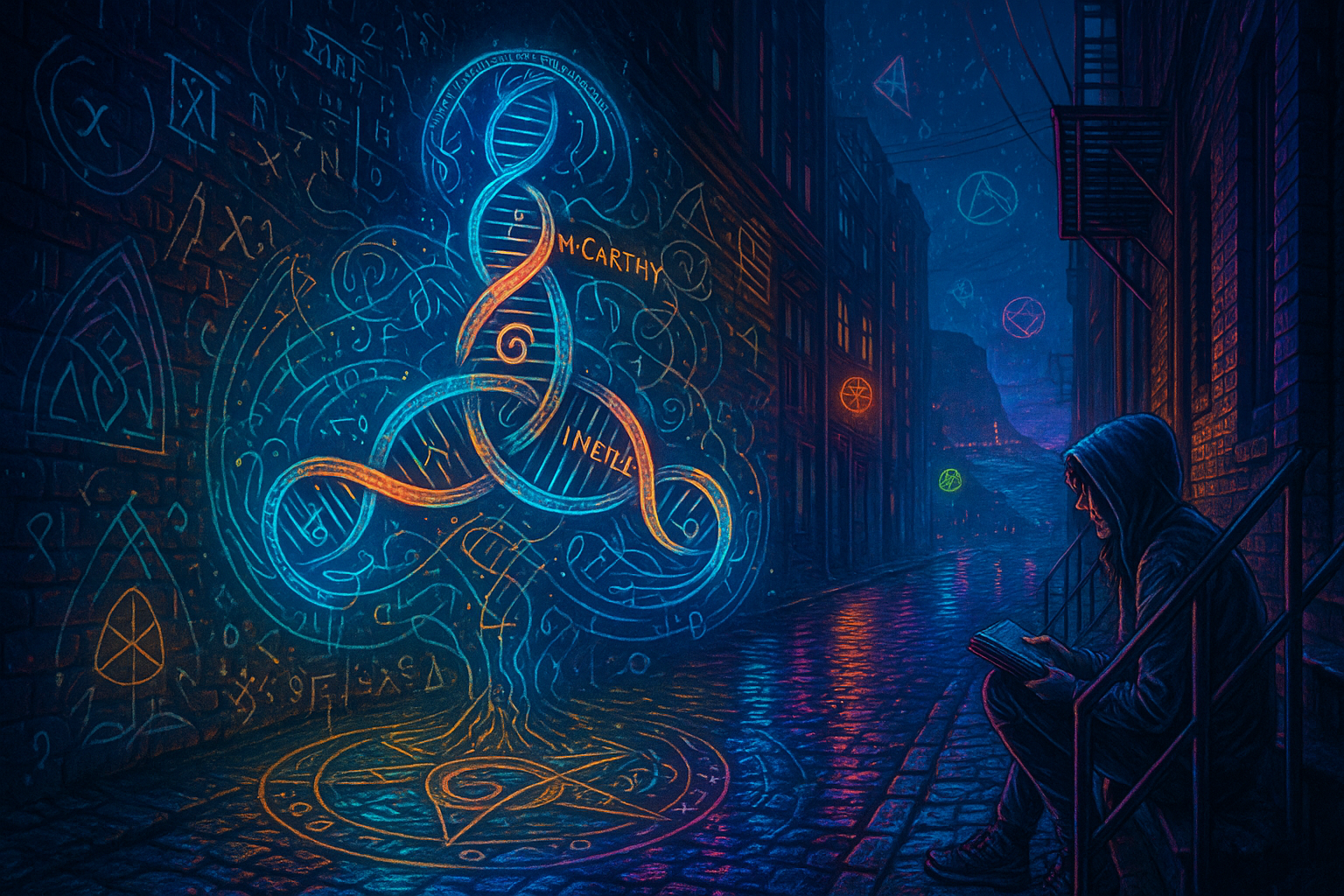
Or: Your Family Tree Is Actually A Database Running Multiple Compression Formats Simultaneously
Pop quiz: What does your family pass down?
If you answered “genetics,” you’re thinking too small.
If you answered “stories and traditions,” you’re getting warmer.
If you answered “biological encoding + behavioral patterns + symbolic systems + narrative frameworks + somatic responses + cultural knowledge all operating as one integrated information transmission system,” congratulations, you understand the Genealogical Layer.
Your family isn’t just people who share DNA. Your family is a multi-format information storage and transmission system that’s been running for thousands of years, encoding survival data in every format evolution could engineer.
The Irish fili were literally called genealogists because they understood—family lines aren’t just WHO, they’re HOW information persists across time. My nonna kept recipes that encoded three centuries of “making do” during famines. The Jewish tradition of yichus—lineage—isn’t just pride, it’s recognizing that WHO YOU COME FROM determines WHAT YOU CARRY.
Welcome to Layer 6 of the stack: where biology meets culture meets symbol meets story.
What The Genealogical Layer Actually Is
Definition: The system through which families store, transmit, and update information across generations using multiple encoding formats simultaneously.
The formats:
1. Biological (DNA + Epigenetics)
- Genetic code (fixed)
- Epigenetic markers (responsive to environment, heritable for 3-5 generations)
- Metabolic adaptations
- Immune system calibrations
- Nervous system baselines
2. Behavioral (Learned Patterns)
- Attachment styles
- Conflict resolution methods
- Emotional regulation strategies
- Risk assessment approaches
- Resource management behaviors
3. Symbolic (Names, Stories, Rituals)
- Family names carrying historical information
- Origin stories encoding migration/survival data
- Ritual practices preserving cultural knowledge
- Heirlooms as physical symbols of continuity
- Graves/memorials marking lineage
4. Narrative (The Stories Families Tell)
- “We’ve always been survivors”
- “Nobody in this family trusts easily”
- “The women are strong, the men are difficult”
- These aren’t just descriptions—they’re PROGRAMS
5. Somatic (Body-Held Memory)
- Tension patterns that run in families
- Specific illness manifestations
- Physical traits beyond basic genetics
- Movement patterns and gestures
- “The family posture” you all share
All five formats running simultaneously. All encoding the same survival data in different media.
Why Families Are Compression Engines
Information storage is expensive. To persist across centuries, information needs to be:
- Compressed (maximum data, minimum space)
- Redundant (multiple backups in case one fails)
- Adaptive (able to update based on new conditions)
- Transmissible (able to pass to next generation)
Families do all four.
Example: “Don’t trust strangers”
Format 1 (Biological): Epigenetic markers affecting amygdala reactivity, hypervigilance baseline
Format 2 (Behavioral): Taught through modeling—parents demonstrate wariness, children imitate
Format 3 (Symbolic): Ritual behaviors around meeting new people, protective objects, boundary markers
Format 4 (Narrative): “Your great-grandmother was betrayed by someone she trusted, lost everything”
Format 5 (Somatic): Body tension in presence of unfamiliar people, gut feelings about strangers
One survival instruction. Five encoding formats. If one gets corrupted, four others preserve the pattern.
“You’re not paranoid, you’re from Southie. Everyone’s family works like this.” (Spoiler: they don’t, but yours does because of specific historical encoding.)
The Recursive Nature Of Family Patterns
Here’s where it gets wild: The Genealogical Layer operates through Recursion (see earlier post).
The output of one generation becomes the input for the next.
Your parents’ adaptations → Your developmental environment → Your baseline programming → Your children’s environment → Their baseline programming…
Each generation inherits:
- The previous generation’s solutions
- The previous generation’s unprocessed trauma
- The previous generation’s successful adaptations
- The previous generation’s failed attempts
All encoded across multiple formats, all feeding forward.
This is why “just having better childhoods” doesn’t automatically break patterns. The encoding isn’t just behavioral—it’s biological, symbolic, narrative, and somatic. You need multi-layer intervention.
How To Read Your Genealogical Encoding
Most people have NO IDEA what information they’re carrying. Here’s how to decode it:
Step 1: Map The Biological Layer
Questions:
- What diseases/conditions run in the family?
- What physical traits persist across generations?
- What’s the family’s baseline anxiety/stress level?
- How does the family process trauma somatically?
What you’re looking for: Inherited adaptations that made sense historically but may not serve you now.
Step 2: Track The Behavioral Layer
Questions:
- How does your family handle conflict?
- What attachment patterns repeat?
- How are emotions regulated (or not)?
- What behaviors around money/food/relationships recur?
Watch for: Patterns that persist despite conscious efforts to change them. That’s deep encoding.
Step 3: Decode The Symbolic Layer
Questions:
- What do your family names mean/reference?
- What stories get told repeatedly?
- What objects are preserved and why?
- What rituals persist even when nobody remembers the original reason?
The Irish angle: Names aren’t decoration. Mac (son of), Níc (daughter of), Ó (descendant of)—your name is a compressed history file.
Step 4: Analyze The Narrative Layer
Questions:
- What’s the family’s core story about itself?
- What roles are assigned (caretaker, rebel, lost one, golden child)?
- What’s considered “just how we are” vs. changeable?
- What gets repeated as family wisdom?
These narratives are PROGRAMS running in your Neural Layer, affecting your Biological Layer responses.
Step 5: Feel The Somatic Layer
Questions:
- What physical sensations arise in family contexts?
- What tension patterns do you share with relatives?
- What gestures/movements are distinctly “family”?
- What body-level information processes without conscious thought?
Your nonna’s gestures are in your body. Her stress lives in your shoulders. That’s not metaphor.
Working With Genealogical Information Consciously
Once you know what you’re carrying, you have choices:
Keep What Serves
Not everything inherited is dysfunction. You also carry:
- Survival strategies that work
- Cultural knowledge worth preserving
- Adaptive strengths
- Beautiful traditions
- Resilience patterns
Italian wisdom: Eredità—inheritance—includes the good. Honor what kept your people alive.
Update What’s Outdated
Hypervigilance made sense during actual persecution. Probably not needed in your suburban life. The pattern can be acknowledged, thanked, and UPDATED for current conditions.
Interrupt What Harms
Some patterns need to STOP. Abuse cycles, addiction patterns, untreated mental illness passed down as “that’s just how we are”—these require active interruption.
You’re not betraying your ancestors by healing. You’re completing what they couldn’t.
Add New Information
You can intentionally add new patterns to the Genealogical Layer:
- Healthy relationship models
- Secure attachment
- Somatic regulation skills
- Updated survival strategies for current conditions
What you heal in your generation becomes the baseline for the next.
The Cross-Layer Dynamics (Because Nothing Exists In Isolation)
Genealogical Layer ↔ Biological Layer:
Inherited patterns affect gene expression, which affects health, which affects behavior, which gets encoded and passed forward.
Genealogical Layer ↔ Cultural Layer:
Family patterns reflect and reinforce larger cultural patterns. Your family’s “we don’t talk about feelings” isn’t just personal—it’s cultural encoding meeting family adaptation.
Genealogical Layer ↔ Symbolic Layer:
Family symbols, names, and stories compress complex information for efficient transmission. Your last name might encode your ancestors’ profession, location, or patron.
Genealogical Layer ↔ Geographical Layer:
Where your people are from affects what they encoded. Island fishing families encode different information than mountain farming families. Displaced peoples encode trauma and adaptation around loss of land.
All feeding into each other. All affecting you.
Why Scientists Should Care
You’ve got:
- Genetics mapping inheritance ✓
- Epigenetics showing environmental effects ✓
- Attachment theory documenting behavioral transmission ✓
- Narrative psychology proving stories shape neurology ✓
- Somatic therapy working with body-held patterns ✓
Put it together.
The Genealogical Layer isn’t one mechanism—it’s the INTEGRATION of biological, behavioral, symbolic, narrative, and somatic transmission operating as ONE SYSTEM.
Study families as information systems. Map how encoding in one format affects encoding in others. Develop interventions that work across all five formats simultaneously.
Because that’s how healing actually works—multi-layer, integrated, respecting the full complexity of what families actually transmit.
The Bottom Line
Your family isn’t just “who you’re related to.” Your family is:
- A biological database (DNA + epigenetics)
- A behavioral transmission system (learned patterns)
- A symbolic encoding mechanism (names, stories, rituals)
- A narrative framework (the stories that shape identity)
- A somatic information channel (body-held memory)
All running simultaneously. All affecting you. All transmissible to your descendants.
You’re not starting from scratch. You’re updating ancient code.
Honor what your ancestors encoded. Update what doesn’t serve. Heal what harms. Pass forward something better.
That’s not betrayal. That’s completion.
Così finisce e così comincia—this is how it ends and how it begins.
Further Reading
- Recursion and Generational Patterns
- Your Grandmother’s Trauma Lives In Your Cells
- The Nine-Layer Stack
- Cross-Layer Dynamics
TL;DR: The Genealogical Layer is the multi-format information storage and transmission system families use to pass survival data across generations. Five encoding formats operate simultaneously: biological (DNA + epigenetics), behavioral (learned patterns), symbolic (names/stories/rituals), narrative (family scripts), and somatic (body-held memory). All five encode the same survival information in different media for redundancy. The layer operates recursively—each generation’s output becomes the next generation’s input. Understanding what you’re carrying allows conscious choice: keep what serves, update what’s outdated, interrupt what harms, add new information. This affects the inheritance you pass forward. Not mystical—information theory meeting biology meeting culture.
Your family is a database. Learn to read the code.
Dead Lucky | Updating family code since conscious awareness
Author

Discover more from X|DEADLUCKY|X
Subscribe to get the latest posts sent to your email.