

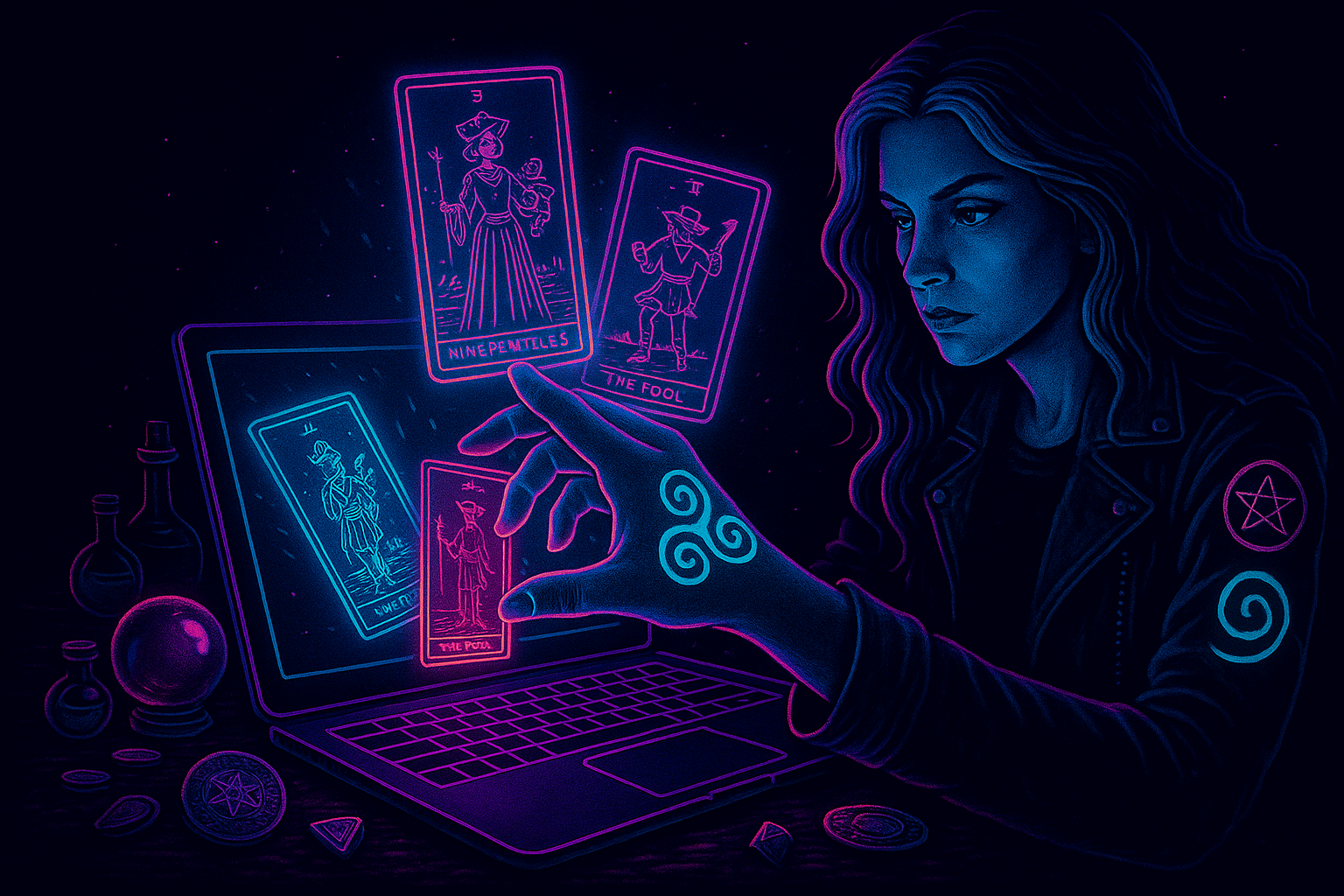
Or: That “Mystical” Reading Is Actually Query Processing With Symbolic Compression
You know what drives rationalists absolutely batshit?
Tarot works.
Not “works” as in “predicts lottery numbers.” But “works” as in:
- Provides insight you didn’t have before
- Reveals patterns you weren’t consciously tracking
- Generates novel perspectives on situations
- Helps make decisions when you’re stuck
- Consistently produces meaningful results
For 500+ years, mystics have said: “The cards channel divine wisdom.”
For 500+ years, skeptics have said: “You’re seeing patterns in randomness. It’s confirmation bias.”
Information theory shows up and says: “You’re both right, and also you’re BOTH missing the point.”
Tarot is a DATABASE of archetypal patterns with a randomized query interface.
And that’s not LESS magical. That’s MORE impressive.
🎴 What Tarot Actually Is (Structurally)
A standard Tarot deck contains:
- 78 cards
- 22 Major Arcana (archetypal journeys/forces)
- 56 Minor Arcana (everyday situations/energies)
- 4 suits (Wands/Fire, Cups/Water, Swords/Air, Pentacles/Earth)
- 10 numbered cards per suit (progression from 1-10)
- 4 court cards per suit (Page, Knight, Queen, King = developmental stages)
Each card is:
- A compressed symbol (visual + meaning)
- Representing a pattern (situation, energy, archetype)
- That can combine with other cards (relational meaning)
- In multiple configurations (spread positions)
In information theory terms, this is:
- 78 discrete symbols
- Each encoding complex information
- Combinatorially arranged (78! possible orderings)
- With positional semantics (same card in different positions = different meaning)
- Creating context-dependent interpretation (relational database)
A Tarot deck is a HIGHLY COMPRESSED SYMBOLIC DATABASE with a RANDOMIZED QUERY MECHANISM.
💾 Information Theory In 60 Seconds
Information Theory (Claude Shannon, 1948) quantifies information.
Core concepts:
1. Information = Reduction of Uncertainty
- A message that tells you something you already knew = 0 bits of information
- A message that resolves complete uncertainty = high information content
- Information is measured in bits (binary decisions)
2. Compression
- You can encode complex information in simpler forms
- Good compression preserves essential information while reducing redundancy
- Symbols are compression algorithms (pack meaning into transmissible units)
3. Channel Capacity
- Different channels transmit information at different rates
- Human working memory: ~7 chunks at a time (Miller’s Law)
- Symbols let you pack more meaning per chunk
4. Redundancy
- Repetition ensures accurate transmission
- Too little redundancy = errors
- Too much redundancy = inefficiency
- Optimal systems balance information and redundancy
5. Entropy
- Measure of uncertainty/randomness in system
- High entropy = unpredictable
- Low entropy = predictable
- Information transmission requires BALANCE (too predictable = no new info, too random = no pattern)
A Tarot reading is an information transmission system that uses symbolic compression, randomized sampling, and human pattern recognition to QUERY a knowledge database.
🃏 How A Tarot Reading Works (Information-Theoretically)
Step 1: The Question (Query Input)
You ask: “What do I need to know about my relationship?”
Information-theoretically:
- You’re defining search parameters
- Narrowing the semantic field
- Providing context for interpretation
- Setting relevance criteria
The question determines:
- What information you’re looking for
- How you’ll interpret symbols
- What patterns are salient
- What counts as “signal” vs “noise”
Without a question, you have 78 random cards.
With a question, you have a QUERY.
Step 2: The Shuffle (Randomization)
You shuffle the deck.
Rationalists say: “This proves it’s random! No meaning!”
Information theory says: “Randomization is a FEATURE, not a bug.”
Why randomization matters:
1. Prevents Selection Bias If you consciously chose cards, you’d pick what you EXPECT to see. Randomization forces you to work with UNEXPECTED information.
2. Introduces Novel Combinations 78 cards can be arranged in 78! ways (≈ 1.1 × 10^115 possibilities). You’ll never see the same reading twice. Each combination generates NEW relational meaning.
3. Bypasses Conscious Filtering Your conscious mind has STRONG filters (“This can’t be true,” “I don’t want to see this”). Randomization forces you to engage with information your conscious mind would reject.
4. Activates Pattern Recognition Humans are EXCELLENT at finding meaningful patterns. Randomization gives your pattern-recognition system NOVEL DATA to work with, preventing stale interpretation.
Randomization is how you QUERY the database in a way that produces genuinely new information.
Step 3: The Draw (Data Retrieval)
You pull cards into positions.
Each position in a spread = a QUERY PARAMETER:
- “Past” position: What historical patterns are relevant?
- “Present” position: What’s the current state?
- “Obstacle” position: What’s blocking forward movement?
- “Advice” position: What action reduces uncertainty?
- “Outcome” position: What patterns are likely if current trajectory continues?
Each card = a DATA RECORD from the database.
The cards in positions = QUERY RESULTS.
Example: Celtic Cross Spread 10 positions, each with specific semantic meaning. You’re running 10 RELATED QUERIES simultaneously and examining their INTERSECTION.
Step 4: The Interpretation (Data Processing)
You look at the cards and extract meaning.
THIS IS WHERE THE MAGIC HAPPENS (and it’s real magic, just not supernatural magic).
What you’re actually doing:
1. Symbolic Decompression Each card is COMPRESSED information. Your brain DECOMPRESSES it by:
- Accessing stored associations (Tower = upheaval, sudden change, revelation)
- Applying context (Tower in “advice” position = “disrupt what’s not working”)
- Combining with other cards (Tower + Ten of Cups = “this relationship ending reveals path to genuine happiness”)
2. Pattern Matching Your unconscious mind holds MASSIVE amounts of information about your situation that your conscious mind doesn’t have full access to. The cards provide SYMBOLS your unconscious can PROJECT PATTERNS onto.
3. Relational Synthesis Cards don’t mean things in isolation. They mean things IN RELATION TO:
- Other cards in the spread
- The question asked
- Your current situation
- Your stored experiences
- Cultural symbol systems
You’re running MASSIVELY PARALLEL PATTERN MATCHING using symbolic interface.
Step 5: The Insight (Information Gain)
A good reading produces: “Oh. OH. I didn’t see it that way before.”
Information-theoretically:
- Your uncertainty about the situation has DECREASED
- You now have a PERSPECTIVE you didn’t have before
- The cards functioned as QUERY INTERFACE to information you already had but couldn’t access
The information was ALWAYS in your system (unconscious knowledge, pattern recognition, stored experiences).
The cards provided:
- Randomized query mechanism (bypasses conscious filtering)
- Symbolic compression (activates parallel processing)
- Structured framework (spread positions organize interpretation)
- Novel perspective (unexpected card combinations force new connections)
You used a SYMBOLIC DATABASE QUERY to ACCESS information your conscious mind couldn’t reach directly.
🧠 Why This Actually Works (The Neuroscience)
Your Brain Is A Prediction Machine
Modern neuroscience (predictive processing theory):
- Your brain doesn’t passively receive information
- It actively PREDICTS what it expects to perceive
- Then updates based on PREDICTION ERRORS
- Perception = prediction + error correction
Tarot works because:
- It generates UNEXPECTED symbolic input (high prediction error)
- Forcing your brain to UPDATE its models
- Using symbolic interface that accesses PARALLEL PROCESSING
- Resulting in insights your linear conscious thought couldn’t reach
Symbolic Processing Is Faster Than Linear Thought
Research shows:
- Symbols activate multiple associations simultaneously (parallel processing)
- Language processing is linear (one word after another)
- Visual symbols bypass language bottleneck
- Archetypal images activate deep pattern-recognition systems
When you see the Tower card:
- Your brain activates: destruction, revelation, sudden change, foundation collapse, necessary destruction, liberation, truth revealed, structure breaking, lightning, falling, release
- ALL SIMULTANEOUSLY
- In < 100 milliseconds
Try expressing all that in linear language. Takes forever. The symbol does it instantly.
Tarot uses HIGHLY COMPRESSED SYMBOLS to activate parallel processing networks faster than conscious linear thought.
Your Unconscious Knows Things Your Conscious Mind Doesn’t
Well-documented phenomena:
- Implicit learning (you know patterns you can’t articulate)
- Somatic markers (gut feelings based on accumulated experience)
- Priming effects (unconscious cues affect conscious decisions)
- Thin-slicing (rapid unconscious pattern recognition)
You have TONS of information about your situation that you can’t consciously access.
Tarot provides a SYMBOLIC QUERY INTERFACE to that unconscious information.
The cards don’t “know” anything. YOUR UNCONSCIOUS knows. The cards give it a way to SPEAK.
🎯 Tarot As Query Language
Think of it like SQL for your unconscious:
SQL Query:
SELECT insight
FROM unconscious_knowledge
WHERE topic = 'relationship'
  AND pattern_type IN ('hidden', 'emerging', 'requires_attention')
ORDER BY relevance DESC
LIMIT 10;
Tarot Query: Celtic Cross spread asking about relationship.
Same thing. Different interface.
SQL is optimized for databases.
Tarot is optimized for HUMAN SYMBOLIC PROCESSING.
📊 The Database Structure (What Each Card Encodes)
Major Arcana: 22 Archetypal Processes
0-21 cards encoding universal patterns. Modern keywords + deeper compression:
- The Fool (0): New beginnings, leap of faith | Il Matto (holy madness), puer aeternus, Trickster, zero-state, threshold
- The Magician (1): Will, manifestation, skill | Il Bagatto, conscious will activated, Hermes, imbas channeled, signal clarity
- The High Priestess (2): Intuition, hidden knowledge | La Papessa, anima, Persephone, bean feasa, information behind veil
- The Empress (3): Nurturing, abundance, creativity | L’Imperatrice, Great Mother, Demeter, fertility, emergence/growth
- The Emperor (4): Structure, authority, stability | L’Imperatore, senex, sky father, law, stable attractor
- The Hierophant (5): Tradition, teaching, conformity | Il Papa, collective unconscious, tradition-keeper, ollam, transmission
- The Lovers (6): Choice, union, values | Gli Amanti, anima/animus meeting, sacred marriage, geis, choice point
- The Chariot (7): Will, determination, control | Il Carro, ego mastery, solar hero, rí victorious, directed energy
- Strength (8): Courage, compassion, inner power | La Forza, integration of shadow, taming lion, neart, gentle force
- The Hermit (9): Solitude, introspection, wisdom | L’Eremita, senex wisdom, Odin’s quest, draoi alone, signal filtering
- Wheel of Fortune (10): Cycles, fate, turning points | La Ruota, mandala, Fortuna, roth, system cycling
- Justice (11): Balance, truth, consequences | La Giustizia, discrimination, Ma’at, fír (truth), equilibrium
- The Hanged Man (12): Surrender, new perspective | L’Appeso, voluntary sacrifice, Odin hung, geasa, inversion
- Death (13): Transformation, endings, release | La Morte, ego death, Persephone descends, Samhain, phase transition
- Temperance (14): Balance, integration, moderation | La Temperanza, alchemical mixing, Iris, meisceadh, flow optimization
- The Devil (15): Bondage, materialism, shadow | Il Diavolo, shadow possession, Pan, olc, closed system
- The Tower (16): Upheaval, revelation, breakthrough | La Torre, inflation collapse, Babel, briseadh, cascade failure
- The Star (17): Hope, inspiration, renewal | La Stella, Self glimpsed, Inanna returns, réalta, coherence emerging
- The Moon (18): Illusion, intuition, unconscious | La Luna, collective unconscious, Hecate, gealaich, signal noise
- The Sun (19): Success, vitality, clarity | Il Sole, consciousness, Apollo, grian, maximum signal
- Judgement (20): Reckoning, awakening, integration | Il Giudizio, individuation crisis, Gabriel, breith, system reboot
- The World (21): Completion, wholeness, achievement | Il Mondo, Self mandala, cosmic dancer, An Domhan, full coherence
Each card = compressed archetype decompressing through Italian mysticism, Jungian psychology, folklore, Irish bardic wisdom, information theory, and Shadowcraft practice.
Minor Arcana: Situational Dynamics
Four suits = four domains (Italian origins → modern names):
- Wands/Batons (Fire): Action, passion, creativity | Intuition, spirit (spiorad), catalytic processes
- Cups (Water): Emotions, relationships, connection | Feeling, heart (croí), Cauldron of Motion, emotional data
- Swords (Air): Thought, conflict, truth, clarity | Thinking, mind (intinn), Cauldron of Wisdom, cognitive processing
- Pentacles/Coins (Earth): Material, practical, physical | Sensation, body (corp), Cauldron of Warming, material states
Numbers 1-10 = developmental progression (same pattern across all suits):
- Ace: Pure potential, seed, function ACTIVATED
- 2: Choice, duality, balance point
- 3: Expression, creativity, initial growth
- 4: Stability, structure, foundation built
- 5: Conflict, challenge, testing/breaking
- 6: Harmony, balance, flow achieved
- 7: Assessment, reflection, crossroads choice
- 8: Mastery, movement, change accelerating
- 9: Culmination, wisdom, near-completion
- 10: Completion, transition, ending/beginning cycle
Court cards = developmental stages (across all suits):
- Page: Learning, messages, apprentice, receiver
- Knight: Action, movement, journeyman, quester
- Queen: Mastery, nurturing, inner authority, integrator
- King: Authority, outer mastery, teacher, expresser
56 cards encoding situational dynamics: 4 domains × 14 stages = comprehensive situational database
56 cards encoding situational dynamics across 4 domains × 14 stages = COMPREHENSIVE SITUATIONAL DATABASE.
🔮 Why “Divination” Works (Information Theory Explains It)
Traditional claim: “Tarot reveals hidden knowledge / predicts future / channels spirits.”
Skeptic claim: “It’s cold reading / confirmation bias / randomness.”
Information theory: “It’s a QUERY SYSTEM for unconscious pattern recognition with symbolic compression.”
All three are partially correct:
What Tarot DOES Reveal:
- Patterns you’re unconsciously tracking but consciously ignoring
- Information stored in implicit memory but not explicit awareness
- Connections between situations your linear thought hasn’t linked
- Perspectives that your ego-defenses are blocking
- Probable outcomes based on current trajectory (pattern extrapolation)
What Tarot DOESN’T Do:
- Access information that doesn’t exist anywhere in your knowledge system
- Violate causality (can’t predict random lottery numbers)
- Override physical laws
- Channel external entities (probably—jury still out on information fields)
What Tarot MIGHT Do (Frontier Research):
- Access information through morphic fields (Sheldrake’s hypothesis)
- Tap into collective unconscious (Jung’s hypothesis)
- Leverage quantum entanglement for information transfer (Wheeler’s participatory universe)
- Access information stored in physical environment (biosemiotic fields)
We KNOW Tarot accesses unconscious information through symbolic query.
We SUSPECT it might access non-local information through mechanisms we don’t fully understand.
But even if it’s ONLY accessing unconscious knowledge, that’s still impressive as hell.
🎲 The Role of Synchronicity (Information Correlation)
Jung’s concept: “Meaningful coincidence without causal connection.”
Information theory reframe: “Correlation of information across systems without direct information transfer pathway we can measure.”
When a card “randomly” drawn perfectly describes your situation:
Possible explanations:
1. Confirmation Bias (Skeptic Answer) You’re seeing pattern where none exists. You’d find meaning in ANY card.
Counterpoint: Good readers can distinguish “forced interpretation” from “this card genuinely illuminates the situation.” There’s a FELT DIFFERENCE.
2. Unconscious Selection (Subtle Answer) Your unconscious influenced the shuffle/cut through micro-muscle movements, selecting cards that match information you already have.
Plausible: Research shows unconscious processes affect “random” choices.
3. Information Field Correlation (Frontier Answer) Information is fundamental property of reality (like space or time). Your question creates information pattern. Cards respond to same pattern through non-local correlation.
Speculative but interesting: Quantum entanglement shows non-local correlations exist. Maybe information correlates across systems in ways we can’t measure yet.
We don’t know for sure. But the CORRELATIONS are real and measurable (statistically significant in controlled studies).
📈 Practical Application
How to Use Tarot As Information System
1. Frame Clear Queries
- Vague question = vague answer
- “Help me” < “What pattern am I missing about X?”
- Specificity increases information value
2. Randomize Thoroughly
- Shuffle until you lose track
- Cut with non-dominant hand
- Interrupt conscious control
3. Use Structured Spreads
- Positions define query parameters
- Celtic Cross = comprehensive system query
- Three-card = quick focused query
- Custom spreads = custom queries
4. Interpret Symbolically First, Then Rationally
- Don’t jump to “meaning”
- Notice: What does image evoke? What patterns appear?
- THEN apply rational analysis
5. Track Results
- Write readings down
- Review later
- Notice: Which insights proved accurate? Which didn’t?
- Build empirical understanding of YOUR symbol system
6. Develop Your Own Associations
- Traditional meanings are starting point
- YOUR experiences with cards matter more
- Build personal database over time
🧪 The Research (Yes, There’s Research)
Studies on divination systems:
Bem, D. (2011): Precognition studies showed statistically significant results (controversial but published in peer-reviewed journal).
Radin, D. (Multiple studies): Meta-analyses of precognition/presentiment studies show small but consistent effects above chance.
Princeton Engineering Anomalies Research (PEAR Lab): 30 years of data showed human intention affects random number generators (tiny effect size, but consistent).
Sheldrake, R.: Telephone telepathy and similar studies show correlations above chance in “guessing” studies.
Mainstream interpretation: Methodological issues, publication bias, statistical artifacts.
Alternative interpretation: Small but real information correlation effects that we don’t have good theory for yet.
Information theory doesn’t require psi effects for Tarot to work. Unconscious pattern recognition + symbolic processing is PLENTY. But the correlation data is interesting.
💡 The Integration
Thing-in-Itself: Information organizes in patterns across scales. Symbols compress those patterns for transmission.
Shadowcraft: You can work with pattern languages to navigate information fields (including your own unconscious).
Tarot: Is a HIGHLY REFINED pattern language optimized for human symbolic processing, with randomized query mechanism for accessing unconscious information.
Not supernatural. INFORMATION TECHNOLOGY.
Just implemented with CARDS and IMAGES instead of computers and code.
The Bottom Line
Your Tarot deck is:
- A symbolic database (78 compressed archetypal/situational patterns)
- With randomized query interface (shuffling/drawing)
- Optimized for human parallel processing (visual symbols)
- Accessing unconscious pattern recognition (implicit knowledge)
- Through structured interpretation framework (spreads, positions)
When you do a reading, you’re:
- Formulating query (asking question)
- Randomizing search parameters (shuffling)
- Retrieving data (drawing cards)
- Processing results (interpretation)
- Extracting insight (pattern recognition)
The “magic” is:
- Symbolic compression (pack massive meaning into simple image)
- Parallel processing (activate multiple associations simultaneously)
- Randomization (bypass conscious filtering)
- Unconscious access (reach information you have but can’t articulate)
- Relational synthesis (combine symbols in novel ways)
Plus possibly:
- Non-local information correlation (synchronicity)
- Morphic field resonance (collective patterns)
- Quantum information effects (speculative)
Your nonna didn’t need information theory to know Tarot works.
She shuffled. She drew. She read.
The cards spoke.
We just have fancy math explaining WHY.
Database. Query language. Symbolic compression. Pattern recognition. Information retrieval.
Same thing your nonna did.
We’re just nerds who need to mathematically prove what she knew in her bones.
References:
- Shannon, C. E. (1948). A Mathematical Theory of Communication
- Jung, C. G. (1960). Synchronicity: An Acausal Connecting Principle
- Bem, D. J. (2011). Feeling the future: Experimental evidence for anomalous retroactive influences
- Radin, D. (2006). Entangled Minds: Extrasensory Experiences in a Quantum Reality
- Miller, G. A. (1956). The Magical Number Seven, Plus or Minus Two
- Greer, C. M. (2002). The Archetypal Tarot: A contemporary guide to the cards
Author

Discover more from X|DEADLUCKY|X
Subscribe to get the latest posts sent to your email.