

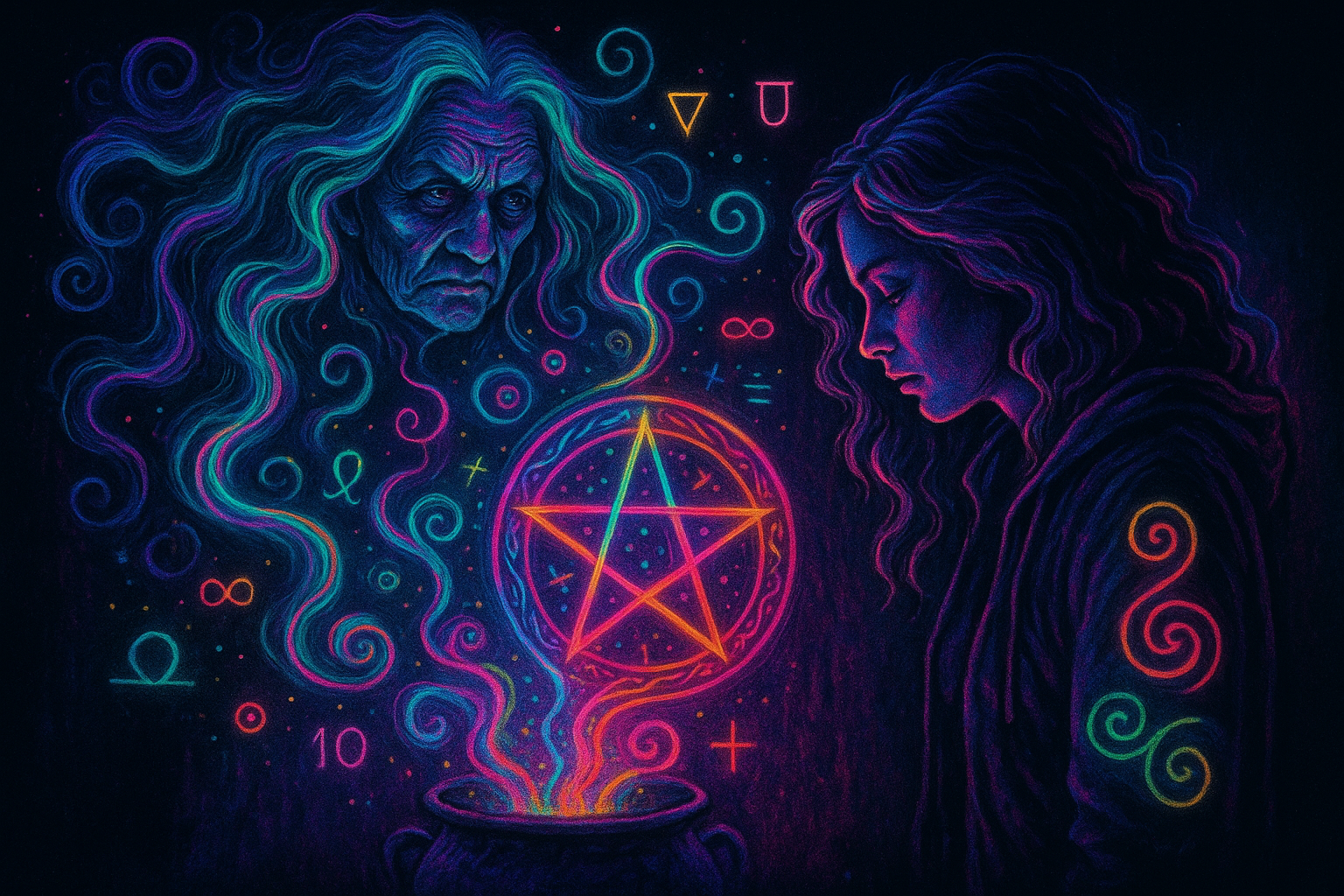
Or: Your Family Drama Is Just Math Being Dramatic
You know that thing where your family keeps having the same fight, generation after generation? Different people, same pattern?
Or how every relationship you get into somehow ends the same way, even though you swear you’re picking different partners?
Or how certain families just seem to attract the same kinds of problems—addiction, financial disaster, tragic love stories—like it’s written in the stars?
It’s not fate. It’s not karma. It’s not even really a “curse” in the mystical sense.
It’s a strange attractor.
And before you go “Lucky, what the hell is a strange attractor and why should I care?”—because understanding this will explain approximately 80% of the bullshit patterns running your life that you thought were either personal failure or cosmic punishment.
Turns out they’re just mathematics being really fucking persistent.
The Irish call it geasa—fate-binding, obligations that constrain behavior. My nonna called it destino—destiny, but the kind you can fight if you’re smart enough. The Yiddish concept of bashert—meant to be—but not in a romantic way, more like “this is the trajectory you’re on unless you intervene.”
Same pattern. Different languages. One mechanism: strange attractors in chaos theory.
What The Hell Is A Strange Attractor? (The Math Part You Actually Need)
In chaos theory, a strange attractor is a pattern that a system naturally evolves toward, even when starting from different conditions.
Think of it like this: You’re a marble rolling around in a bowl. No matter where you start, you eventually end up at the bottom. The bottom is the attractor—the state the system naturally settles into.
Strange attractors are more complex—instead of settling into one point, the system traces the same pattern over and over, never quite repeating exactly but never escaping the overall shape.
Real-world example: Weather patterns. Each day is unique, but seasons repeat. You can’t predict exactly what happens Tuesday, but you can predict “winter will be cold.” The seasonal pattern is the attractor.
The Key Properties
1. Self-organizing
The system finds this pattern without external direction. It’s emergent.
2. Stable within range
Small perturbations don’t break the pattern. The system returns to the attractor.
3. Fractal structure
The same pattern appears at different scales. Zoom in, same structure. Zoom out, same structure.
4. Sensitive to initial conditions
Small differences at the start can lead to different variations of the pattern, but they’re all variations of THE SAME PATTERN.
This is why:
- Families repeat patterns despite conscious efforts to change
- You keep attracting the same relationship dynamics
- Cultural systems persist across generations
- Breaking the pattern requires massive, sustained intervention
How Strange Attractors Show Up In Your Life (The Part You Came For)
Family Strange Attractors (AKA “Generational Curses”)
The pattern: Your great-grandmother had an alcoholic husband. Your grandmother married an alcoholic. Your mother swore she’d never marry an alcoholic, married someone “different”… who turned out to be an alcoholic. You’re dating someone who “isn’t like that”… but displays the warning signs.
What’s happening: The family system has a strange attractor around dysfunctional partnership dynamics. The specifics vary (different people, different substances, different expressions), but the underlying pattern persists.
The mechanism:
- Biological Layer: Epigenetic markers from ancestral stress
- Neural Layer: Learned relationship models, trauma responses, attachment patterns
- Genealogical Layer: Pattern inheritance through observation + biology
- Cultural Layer: Family narrative (“we just have bad luck with men”)
The math: Initial conditions (traumatized ancestors) created an attractor basin (dysfunctional relationship patterns). Descendants start from different points but get pulled toward the same pattern.
Why “trying harder” doesn’t work: You’re fighting a strange attractor with willpower. The attractor is mathematically stable. You need to change the underlying structure, not just make better decisions.
Relationship Strange Attractors (Why You Keep Dating The Same Person In Different Bodies)
The pattern: You swear off emotionally unavailable partners. Next relationship starts great. Six months in, they’re emotionally unavailable. You leave. Next partner, repeat.
What’s happening: Your nervous system has a strange attractor around “familiar” relationship dynamics. “Familiar” doesn’t mean “good”—it means “matches the pattern your system recognizes.”
The mechanism:
- Neural Layer: Your brain predicts based on past experience
- Biological Layer: Your body recognizes “safe” (known patterns) vs “threat” (unknown patterns)
- Attachment patterns: Formed early, stabilize into attractors
The trap: Emotionally available partners feel “wrong” or “boring” because they don’t match your attractor. Your nervous system interprets unfamiliar as threat, even when unfamiliar is actually healthy.
The Italian angle: Mal d’amore—lovesickness, but it’s really attractor-sickness. You’re addicted to the pattern, not the person.
Career/Money Strange Attractors (The “Self-Sabotage” That Isn’t)
The pattern: You finally get ahead financially. Then unexpected expenses wipe out savings. Or you quit the good job. Or you make a decision that tanks your progress. Repeat every time you approach a certain financial level.
What’s happening: You have a strange attractor around a specific financial state. When you move too far from it, the system “corrects” back toward the familiar pattern.
The mechanism:
- Genealogical Layer: Inherited class consciousness, poverty trauma
- Neural Layer: Comfort zone, predictive models
- Cultural Layer: Family narratives about money
- Symbolic Layer: “We’re not those kind of people”
Why it feels like self-sabotage: It’s not conscious. Your system is returning to the attractor because that’s what systems DO. The attractor is stable. Deviation feels dangerous.
The Boston translation: “Who do you think you are?” is the family attractor talking.
Cultural Strange Attractors (Why Societies Keep Making The Same Mistakes)
The pattern: Boom-bust economic cycles. Rise and fall of empires. Recurring wars. Social movements advancing then getting crushed, then re-emerging decades later.
What’s happening: Collective systems have strange attractors too. Different specific events, same underlying pattern.
Examples:
- Wealth inequality → social unrest → brief reform → return to inequality (attractor: concentrated power)
- Innovation → consolidation → stagnation → disruption (attractor: boom-bust cycles)
- Rights movements → backlash → compromise → slow progress (attractor: oscillation between change and stability)
Why “this time will be different” usually isn’t: You’re in an attractor basin. Without changing the underlying structure, the system returns to the familiar pattern.
The Math Behind The Pattern (Why Attractors Are So Stable)
Energy Efficiency
Strange attractors are energetically favorable. The system naturally settles into them because they minimize energy expenditure.
Translation: Your family’s dysfunction is EFFICIENT from the system’s perspective. It requires less energy to maintain the familiar pattern than to create a new one.
This is why change is hard: You’re fighting thermodynamics. The attractor is stable because it’s efficient. Breaking it requires sustained energy input.
Fractal Persistence
The pattern appears at multiple scales simultaneously:
- Individual relationships mirror family patterns
- Family patterns mirror cultural patterns
- Cultural patterns mirror historical patterns
You can’t escape by changing scale—you have to change the pattern itself.
My nonna understood this: Come la famiglia, così la vita—as the family, so the life. The fractal repeats.
Feedback Loops
Attractors maintain themselves through feedback:
- Pattern creates outcomes
- Outcomes reinforce belief in pattern
- Belief shapes behavior
- Behavior recreates pattern
Example:
“We’re not good with money” (belief) → poor financial decisions (behavior) → financial problems (outcome) → “See, we’re not good with money” (reinforced belief)
The loop is self-sustaining.
Breaking Strange Attractors (Because You Can, But It’s Not Easy)
Good news: Attractors can be destabilized and replaced.
Bad news: It requires massive, sustained intervention at multiple layers simultaneously.
Step 1: Identify The Attractor (Pattern Recognition Required)
What keeps happening? Not the surface details—the underlying pattern.
- Not “I keep dating alcoholics”—”I keep choosing emotionally unavailable partners”
- Not “my family fights about money”—”my family avoids conflict until explosion”
- Not “I can’t keep a job”—”I sabotage success when I approach a specific threshold”
Name the shape of the attractor, not its current expression.
The Irish fili trained in imbas forosnai—sudden illumination—because sometimes you need to see the pattern all at once to understand it.
Step 2: Trace It Back (Genealogical Archaeology)
When did this attractor form? What event or trauma created these initial conditions?
You’re not looking to blame anyone. You’re looking to understand the attractor’s origin so you can see where it’s pulling you toward.
Step 3: Interrupt At Multiple Layers (Cross-Layer Intervention)
You can’t just “think positive” your way out of an attractor. You need intervention at:
Biological Layer:
- Nervous system regulation (vagal work, somatic therapy)
- Shift baseline arousal patterns
- Create new “safe” baselines
Neural Layer:
- Cognitive reframing
- New predictive models
- Pattern interruption practices
Genealogical Layer:
- Shadow work on inherited patterns
- Family systems therapy
- Conscious choice to break inheritance
Symbolic Layer:
- Rewrite the story
- Create new narratives that allow for different outcomes
- Ritual marking of transformation
Cultural Layer:
- Find/create communities that support the new pattern
- Surround yourself with people living different attractors
Step 4: Create A New Attractor (This Takes Years)
You can’t just destroy the old attractor—you have to build a new one.
The mechanism: Repetition. Consistency. Time.
The new pattern has to become MORE energetically favorable than the old one. This requires:
- Sustained practice (years, not months)
- Multiple reinforcement channels
- Community support
- Ritual structure
The Yiddish wisdom: Trop trop vert men a mentsh—drop by drop, one becomes a person. Small consistent changes compound.
Step 5: Expect Snapback (And Plan For It)
When you move away from an attractor, the system will try to pull you back.
This shows up as:
- Sudden “coincidences” that recreate the old pattern
- Family members unconsciously sabotaging your changes
- Intense anxiety when you approach new territory
- Crisis events that “require” return to old patterns
This isn’t the universe punishing you. It’s the attractor’s mathematical stability trying to reassert itself.
Irish concept: Imscaradh—the separation. There’s a tearing-away period that’s brutal but necessary.
Preparation: Expect it. Build support systems. Don’t interpret snapback as failure—it’s expected dynamics.
Why Scientists Should Care (Put The Pieces Together Already)
You’ve got chaos theory. You’ve got dynamical systems modeling. You’ve got:
- Attachment theory (relationship attractors)
- Family systems theory (generational attractors)
- Economic cycle theory (cultural attractors)
- Neuroscience on habit formation (neural attractors)
You’re looking at the same mechanism across all layers and calling it different things.
Map the unified attractor architecture. Study how:
- Biological attractors (nervous system baselines) interact with psychological attractors (behavioral patterns)
- Genealogical attractors (inherited patterns) create individual attractors (personal patterns)
- Cultural attractors (collective patterns) constrain individual attractors
And fund the goddamn research on pattern interruption and attractor replacement at scale.
Because right now we’re treating symptoms (individual therapy) when we need systemic intervention (multi-layer attractor destabilization).
Further Reading
- Recursion and Generational Patterns: Why Families Repeat
- Threshold Dynamics: The Mechanics of Transformation
- Cross-Layer Dynamics: How Ritual Actually Works
- The Nine-Layer Stack
TL;DR: Strange attractors are patterns systems naturally evolve toward and maintain despite perturbations. They’re fractal (same pattern at different scales), self-organizing (emerge without direction), and stable (resist change). Your family patterns, relationship patterns, money patterns, and even cultural patterns are strange attractors operating through Biological + Neural + Genealogical + Cultural + Symbolic Layers simultaneously. Breaking them requires identifying the attractor, tracing its origin, interrupting at multiple layers, building a new attractor through sustained practice, and expecting/planning for snapback. This isn’t mystical—it’s chaos theory applied to human systems. Your “curse” is just math being really fucking persistent.
Change the math. Change the pattern.
Dead Lucky | Attractor breaker since the first snapback
Author

Discover more from X|DEADLUCKY|X
Subscribe to get the latest posts sent to your email.