

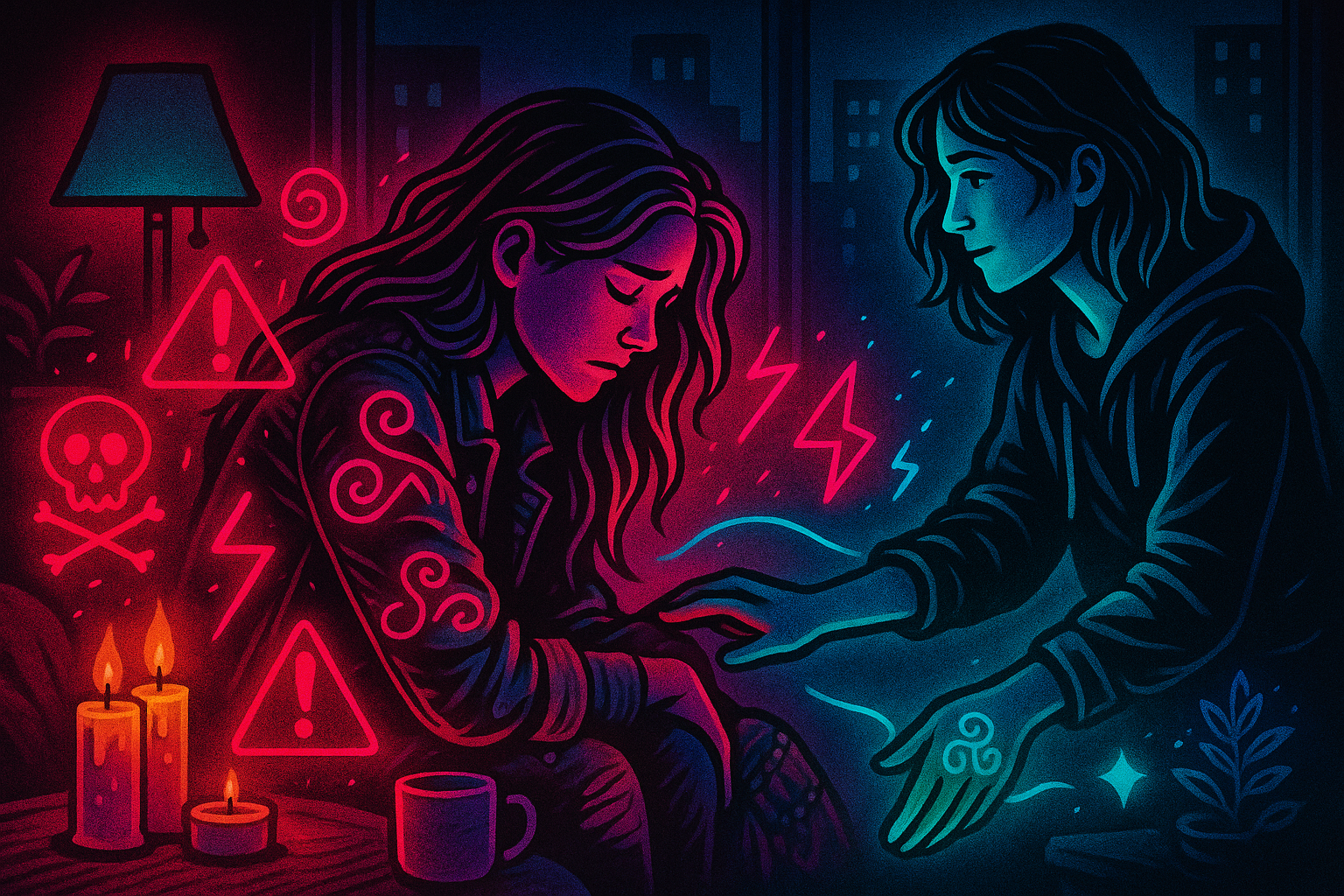
Or: The Warning Signs You’re Headed For A Crash (And What To Do About It)
Just so we are clear, most people don’t crash suddenly.
They crash slowly, ignoring red flags the whole way down, until they’re in full crisis wondering “how did I get here?”
I’ll tell you how: By dismissing every warning sign your system gave you because you thought you knew better.
“I segnali ci sono sempre“—the signs are always there. You just have to be willing to see them.
The Irish fili trained their students to recognize when practice was tipping from productive to dangerous. Not because they were cautious—because they’d watched people lose themselves trying to push through red flags.
These warning signs exist for a reason.
Learn them. Respect them. Act on them.
Before you’re the next person in crisis going “I didn’t see it coming.”
Yes, you did. You just ignored it.
Category 1: Reality-Testing Deterioration
These are STOP IMMEDIATELY signals.
Red Flag: Can’t Distinguish Internal From External
What it looks like:
- Your thoughts feel like they’re coming from outside you
- Other people’s thoughts feel like they’re in your head
- Can’t tell if something actually happened or you imagined it
- Memories and present blur together
Why it’s dangerous: Your reality-testing is failing. You’re losing the ability to navigate shared reality.
What to do:
- STOP all consciousness practices immediately
- Contact your support people RIGHT NOW
- Get reality-anchoring (spend time with trusted person, do grounding practices)
- Don’t resume practice until reality-testing is solid again
Red Flag: Escalating Certainty
What it looks like:
- Every insight feels ABSOLUTELY TRUE
- Can’t tolerate uncertainty or “I don’t know”
- Questioning feels like attack
- You’re 100% sure about things that can’t be verified
Why it’s dangerous: Loss of epistemic humility. You’re losing capacity for self-correction.
What to do:
- Notice you’re in certainty escalation
- Reality-check EVERY “absolute truth” with witnesses
- Practice saying “I think… but I could be wrong”
- If you can’t tolerate being wrong: STOP, get support
Red Flag: Pattern Recognition Without Reality-Checking
What it looks like:
- Seeing patterns EVERYWHERE without checking if they’re real
- License plates, songs, conversations all “mean something”
- Synchronicities multiply without verification
- Can’t distinguish meaningful patterns from noise
Why it’s dangerous: Your pattern recognition is unbounded. You’re generating false connections.
What to do:
- Reality-check EVERY pattern with witness before acting on it
- Practice acknowledging “might be reaching here”
- If witnesses consistently don’t see your patterns: STOP
Category 2: Functioning Breakdown
These indicate your practice is overwhelming your capacity.
Red Flag: Sleep Disruption
What it looks like:
- Can’t sleep for multiple nights (not just one bad night)
- “Don’t need sleep” feeling
- Sleep but wake up unrested/more activated
- Dreams so intense they’re more real than waking
Why it’s dangerous: Your nervous system needs rest to integrate. No rest = no integration = crash.
What to do:
- Prioritize sleep over practice IMMEDIATELY
- Reduce practice intensity
- Get sleep support (melatonin, sleep hygiene, medical help if needed)
- Don’t resume full practice until sleep normalizes
Red Flag: Appetite/Eating Changes
What it looks like:
- Not eating for days (“food seems irrelevant”)
- Can’t taste food/everything tastes wrong
- Forgetting to eat entirely
- Eating only one thing obsessively
Why it’s dangerous: Your body needs fuel. Malnutrition amplifies instability.
Note:
If you practice ritual or religious fasting, that’s a different category—as long as the fasting is intentional, structured, time-limited, and you’re physically stable. The red flag is unintentional starvation driven by overwhelm or dissociation, not purposeful practice.
What to do:
- Set alarms to eat something every few hours
- Ask someone to bring you food/eat with you
- Even if you’re not hungry: EAT SOMETHING
- If appetite doesn’t return: get medical check
Red Flag: Basic Self-Care Declining
What it looks like:
- Not showering/brushing teeth for days
- Living space becoming chaotic/filthy
- Not doing laundry/dishes/basic maintenance
- Bills not getting paid/responsibilities ignored
Why it’s dangerous: These are executive function failures. Your system is overloaded.
What to do:
- Accept help with basic tasks
- Lower practice intensity IMMEDIATELY
- Focus on stabilization, not advancement
- Don’t resume until basic functioning returns
Red Flag: Work/School Performance Dropping
What it looks like:
- Can’t focus on tasks
- Missing deadlines/appointments
- Making unusual mistakes
- Coworkers/teachers expressing concern
Why it’s dangerous: You’re losing capacity to function in external reality.
What to do:
- Reduce practice to minimal maintenance
- Be honest with support people that you’re in intensity
- Get help managing responsibilities
- Don’t increase practice until performance stabilizes
Category 3: Relationship Disruption
These indicate isolation and loss of external perspective.
Red Flag: Withdrawing From Everyone
What it looks like:
- Canceling plans repeatedly
- Not responding to messages
- Avoiding people who “don’t understand”
- Convinced you need to “do this alone”
Why it’s dangerous: Isolation removes reality-checking. You spiral with no external correction.
What to do:
- Force contact even when you don’t want it
- Tell someone you’re isolating (awareness helps)
- Weekly minimum contact with anam cara/support person
- If you’re resisting ALL contact: emergency—get help NOW
Red Flag: Conflicts Escalating
What it looks like:
- Fighting with people who usually support you
- Everyone seems “against you” or “not getting it”
- Relationships fracturing rapidly
- People saying they’re scared for you
Why it’s dangerous: Your support network is trying to tell you something. You’re not hearing it.
What to do:
- LISTEN to multiple people’s concerns (if 3+ people worried: THEY’RE RIGHT)
- Ask directly: “Am I losing it? Be honest.”
- Accept that if everyone’s concerned, you’re probably in trouble
- Get help stabilizing before continuing
Red Flag: Only Connecting With Others In Practice
What it looks like:
- Only talking to people in your consciousness work community
- Dismissing anyone who questions the practice
- “Us vs them” mentality developing
- Outside relationships deteriorating
Why it’s dangerous: Echo chamber. No external reality-checking. Cult dynamics forming.
What to do:
- Maintain relationships OUTSIDE practice community
- Value external perspective over internal agreement
- If community discourages outside reality-checking: LEAVE
- Healthy practice supports all your relationships
Category 4: Practice-Specific Red Flags
These indicate the practice itself is becoming harmful.
Red Flag: Increasing Practice Despite Worsening Outcomes
What it looks like:
- Things getting worse but you’re practicing MORE
- “I just need to push through”
- Ignoring warning signs
- Convinced more practice will fix it
Why it’s dangerous: You’re in compulsion, not practice. This is how people crash spectacularly.
What to do:
- STOP. You’re making it worse.
- Reduce practice to absolute minimum
- Get external assessment from someone NOT in the practice
- Sometimes the answer is STOP ENTIRELY, not do more
Red Flag: Can’t Stop Even When You Want To
What it looks like:
- Trying to take breaks but “pulled back in”
- Practice feels compulsive, not chosen
- Anxiety when you don’t practice
- “Need” practice to function
Why it’s dangerous: You’re dependent. The practice has become addiction-like.
What to do:
- This requires outside help—you can’t assess this yourself
- Talk to anam cara or support person
- Consider if practice is helping or harming
- Sometimes you need to stop completely to reset
Red Flag: Bypassing Problems With Practice
What it looks like:
- Using practice to avoid dealing with actual life issues
- “Processing” instead of acting
- Spiritual language for psychological avoidance
- Practice making life problems worse, not better
Why it’s dangerous: Spiritual bypass. Practice becomes escape mechanism, not development.
What to do:
- Get honest about what you’re avoiding
- Address actual problems directly
- Use practice to SUPPORT life, not escape it
- If practice consistently helps you avoid: STOP
Red Flag: Practice Requiring Secrecy
What it looks like:
- Hiding what you’re doing from loved ones
- Feeling like you can’t tell people
- Community/teacher says “others won’t understand”
- Secrecy feels necessary
Why it’s dangerous: Healthy practices don’t require secrecy. This is cult behavior.
What to do:
- Tell someone outside the practice what you’re doing
- If practice can’t withstand outside scrutiny: IT’S NOT SAFE
- Secrecy = red flag for abuse/manipulation
- LEAVE situations that require secrecy
Category 5: Physical Warning Signs
Your body is telling you something. LISTEN.
Red Flag: Physical Symptoms Escalating
What it looks like:
- Constant heart racing/palpitations
- Can’t sit still/constant agitation
- Unexplained pain
- Feeling like you’re vibrating/buzzing constantly
- Dissociation increasing
Why it’s dangerous: Your nervous system is in distress. Body is emergency-signaling.
What to do:
- Medical check-up (rule out physical causes)
- STOP practice until physical symptoms resolve
- Nervous system stabilization work
- Don’t resume until body is stable
Red Flag: Substance Use Increasing
What it looks like:
- Using substances to manage practice intensity
- Needing substances to “come down”
- Increasing frequency/amount
- Can’t practice without substances
Why it’s dangerous: You’re self-medicating overwhelm. Practice is destabilizing you.
What to do:
- STOP consciousness practice immediately
- Address substance use
- Get assessment from someone outside practice
- Don’t resume until stable without substances
The Response Protocol (What To Actually Do)
When you notice red flags:
Step 1: STOP
Immediately reduce or cease practice.
Don’t “push through.” Don’t “trust the process.” STOP.
Step 2: TELL SOMEONE
Contact your anam cara/support person.
“I’m seeing these red flags: [list them]. I need reality-checking.”
Step 3: REALITY-CHECK
Ask directly:
- “Am I making sense?”
- “Do you see what I’m seeing?”
- “Am I losing it?”
- “What do you think I should do?”
LISTEN to their answers even if you don’t like them.
Step 4: STABILIZE
Focus on basics:
- Sleep
- Food
- Physical grounding
- External reality contact
- Reduce all practice to minimum
Step 5: ASSESS
With support people, figure out:
- What went wrong?
- Did I skip foundation?
- Did I ignore earlier warnings?
- Do I need to stop entirely or just recalibrate?
Step 6: DECIDE
Options:
- Return to Phase 1 (rebuild foundation)
- Take extended break (months)
- Stop this practice entirely
- Get additional support before continuing
The Yiddish wisdom: Besser tsu blaybn gezunt—better to stay healthy. Your wellbeing > your practice.
Red Flags In Teachers/Communities (Get Out)
If teacher/community shows these:
- Discourages outside reality-checking
- Claims questioning = lack of faith
- Isolates practitioners from other relationships
- Demands money/loyalty before teaching safety
- Pushes past boundaries
- Shames limits
- Claims their way is the only way
- Makes leaving difficult
These are abuse/cult dynamics. RUN.
The Bottom Line
Red flags are your system’s warning signs.
Category 1: Reality-testing deterioration (STOP IMMEDIATELY)
Category 2: Functioning breakdown (reduce intensity, stabilize)
Category 3: Relationship disruption (get external perspective)
Category 4: Practice-specific (assess if practice is helping or harming)
Category 5: Physical warnings (body in distress)
When you see red flags:
- STOP practice
- Tell someone
- Reality-check
- Stabilize
- Assess
- Decide next steps
Don’t ignore warning signs.
Don’t push through red flags.
Don’t convince yourself you’re “fine” when multiple people are concerned.
Your system is telling you something. LISTEN.
I segnali ci sono sempre, cara. The signs are always there, love.
Dead Lucky | Red flag recognizer, crash survivor, warning sign respector
Author

Discover more from X|DEADLUCKY|X
Subscribe to get the latest posts sent to your email.