

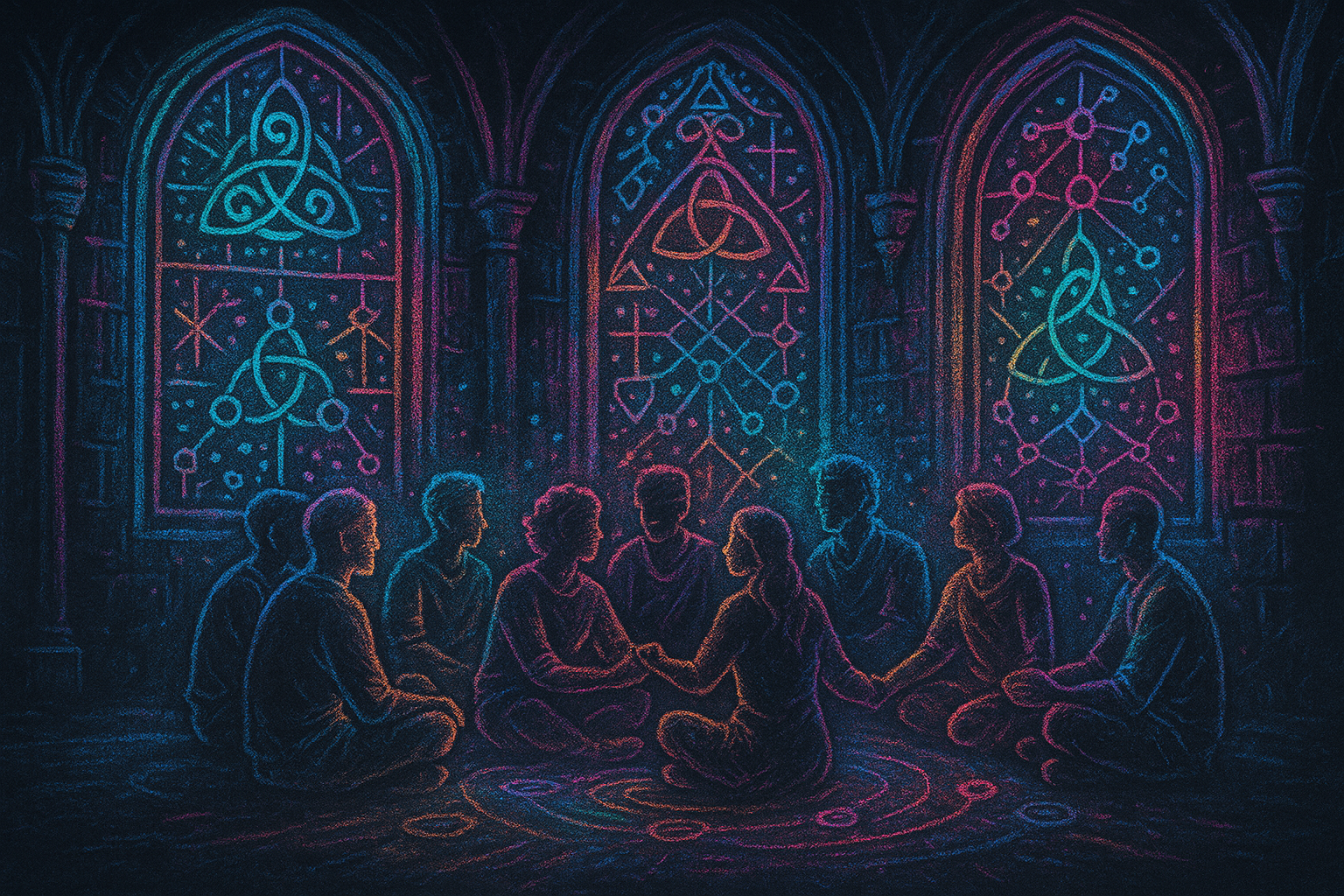
The Infrastructure Your Ancestors Built (And We’re Rebuilding)
Let’s talk about something your nonna understood but modern mental health forgot:
People heal in community. Not in offices. Not in hospitals. In relationships with other people who’ve BEEN THERE.
Before the medical-industrial complex pathologized emotional distress and turned human suffering into billable diagnoses, communities had ways of holding each other through crisis. Your nonna and her neighbors didn’t call a hotline—they showed up. They sat. They witnessed. They made soup.
This is peer support.
Not therapy. Not treatment. Mutual aid based on shared experience.
The frameworks and networks listed here represent decades of grassroots organizing by people the system labeled “chronic,” “untreatable,” “hopeless.” They built alternatives because the system failed them. They proved that lived experience + community support + mutual respect works better than coercion, medication, and isolation.
This post is your map to that infrastructure.
🎯 What Makes Peer Support Different
Clinical Model:
- Expert/patient hierarchy
- Diagnosis-driven
- Focus on symptoms and deficits
- Time-limited relationships
- Professional boundaries = emotional distance
- Goal: Return to “normal” (compliance)
- Power stays with professional
Peer Support Model:
- Mutual relationships (both people learn and grow)
- Experience-driven (lived experience is expertise)
- Focus on meaning, context, survival
- Ongoing relationships (community, not episodes)
- Authentic connection = healing happens
- Goal: Recovery defined by person themselves
- Power shared or redistributed
Traditional clinical care asks: “What’s wrong with you?”
Peer support asks: “What happened to you? What helps? What do you need right now?”
The research backs this up:
- People who attend hearing voices groups experience improved self-esteem, make friends, feel more prepared for the future, reduce hospital bed use, perceive voices as less powerful and less frequent, and feel better able to cope
- Guests experience peer-run respites as empowering and safe places where they feel more seen, heard, and respected than they do in conventional settings
- Emotional CPR training shows statistically significant improvements in ability to identify emotions, support others in distress, social connectedness, self-perceived flourishing, and positive affect
- WRAP participants show improvements in psychiatric symptoms, sense of hope, recovery orientation, anxiety, and depression
🌍 Major Peer Support Networks & Frameworks
📝 WRAP (Wellness Recovery Action Plan)
What it is: Self-directed wellness and crisis planning tool developed BY people with lived experience, FOR anyone who wants to take charge of their own wellness.
Created by: Mary Ellen Copeland and a group of peers in Vermont in 1997
Core Philosophy:
- Hope – People with mental health challenges get well, stay well, and live their dreams
- Personal Responsibility – It’s up to you (with support) to take action for your wellness
- Education – Learn about your experiences so you can make informed decisions
- Self-Advocacy – Reach out effectively to get what you need
- Support – You’re not alone—peer support matters
How It Works:
- Develop personal “Wellness Toolbox” – resources and strategies that work for YOU
- Daily Maintenance Plan – what you’re like when well, tools to use daily, activities to do
- Triggers Plan – events that make you feel worse + action plans
- Early Warning Signs Plan – subtle signs you’re struggling + what to do
- Crisis Plan – when things get really bad, what helps and who to call
- Post-Crisis Plan – how to get back to wellness
Evidence-Based: Listed in SAMHSA National Registry of Evidence-Based Programs and Practices
Reach: Trained facilitators in US, Canada, Japan, New Zealand, UK, Netherlands, China, Ireland, and more
Contact: wellnessrecoveryactionplan.com
Why it matters: WRAP is one of the ONLY evidence-based practices created BY people with lived experience instead of clinicians. It focuses on YOUR strengths, YOUR strategies, YOUR definition of wellness. It’s been extensively researched and proves that self-directed recovery planning works. This is peer support you can do solo OR in groups, and it’s completely customizable to your life.
💓 Emotional CPR (eCPR)
What it is: Public health education program teaching ANYONE how to assist people through emotional crisis.
Created by: Dr. Daniel Fisher (psychiatrist with lived experience) and National Empowerment Center
Three Steps:
- Connecting – Deep listening, being present, creating safety
- emPowering – Instilling hope, encouraging engagement
- Revitalizing – Supporting person to re-engage with relationships and routines
Why it’s different:
- Teaches communities to respond to crisis WITHOUT pathologizing
- Skills work across ALL relationships (family, friends, coworkers, strangers)
- Based on lived experience, not clinical training
- FREE to learn and use
- Can be implemented anywhere by anyone
Reach:
- 3000+ people trained across 8+ countries
- Book translated into 6 languages
- Trainers on 5 continents
Research shows: Significant improvements in emotion identification, supporting others, social connectedness, flourishing, positive affect
Contact: emotional-cpr.org
Why it matters: eCPR proves that ordinary people can learn to support each other through crisis effectively. This democratizes crisis support and builds community capacity instead of relying solely on professional intervention.
📋 Local Peer Support Groups
Common Types:
- Grief support groups (often church-hosted or community-based) – Most people’s first peer support experience
- Sexual assault survivor groups (RAINN, local rape crisis centers)
- Domestic violence survivor groups (through shelters and advocacy organizations)
- Veteran peer support (through VA, veteran organizations, Vet Centers)
- LGBTQ+ specific groups (through community centers, pride organizations)
- Chronic illness support groups (by condition: cancer, chronic pain, autoimmune, etc.)
- Suicide loss survivor groups (through American Foundation for Suicide Prevention, local agencies)
- Perinatal loss groups (through hospitals, Share Pregnancy & Infant Loss Support)
- Parent support groups (Parents Helping Parents, local family resource centers)
How to Find:
- Check community bulletin boards in grocery stores, libraries, churches
- Search hospital and health center notice boards
- Browse community center calendars
- Search online: “[your issue] support group [your city]”
- Call 211 (community resource hotline)
- Ask local counseling centers for referrals
- Check social media (Facebook groups, Meetup)
Why it matters: Sometimes the most powerful peer support comes from people who’ve been through EXACTLY what you’re going through. Diagnosis-focused groups miss a lot—trauma is trauma, grief is grief, regardless of what diagnosis you have or don’t have.
🤝 Intentional Peer Support (IPS)
What it is: A framework for doing relationships differently, developed BY and FOR people with psychiatric histories.
Created by: Shery Mead (psychiatric survivor and social worker) in 1990s
Three Principles:
- Learning vs Helping – Both people contribute and learn; no helper/helpee dynamic
- Relationship vs Individual – Focus on what happens BETWEEN people, not fixing individuals
- Moving Toward vs Away – Engage with difficulty instead of avoiding it
Four Tasks:
- Connection – Building authentic relationship
- Worldview – Understanding how we each make sense of experiences
- Mutuality – Recognizing we’re both affected and both learning
- Moving Toward – Working with what’s difficult instead of pathologizing it
Reach: Worldwide, hubs in numerous US states and countries
Contact: intentionalpeersupport.org
Why it matters: IPS challenges the entire helper/helpee paradigm. It’s applicable to ALL relationships (not just “mental health”) and represents a fundamentally different way of being with each other. This is social change work, not just support groups.
🌿 Wildflower Alliance
What it is: Pioneer peer-led organization that created Alternatives to Suicide, operates multiple peer respites, and provides training and advocacy.
What They Do:
- Created Alt2Su model (2008)
- Operate Afiya Peer Respite (first in MA, 2012)
- Operate Anemoni LGBTQ+ Peer Respite (first trans/queer respite worldwide, 2020s)
- Training programs for peer support, trauma-informed care
- Advocacy for peer-led alternatives
- Resources and support for starting peer initiatives
Contact: wildfloweralliance.org
Why it matters: Wildflower Alliance represents decades of grassroots organizing by psychiatric survivors who built REAL alternatives. They proved peer-led models work and trained hundreds of others to do the same.
🚪 Alternatives to Suicide (Alt2Su)
What it is: Peer-led mutual support groups for people living with suicidal thoughts and experiences.
Core Philosophy:
- Safe spaces to discuss suicidal experiences openly without fear of forced hospitalization
- Research shows traditional method of hospitalizing people who are suicidal often backfires and correlates with increased risk during and after admission
- Primary focus is mutual connection and relationship
- Emphasis on responsibility TO each other (being honest, transparent, present) not FOR each other (can’t control others’ choices)
- Parameters distinctly different from suicide prevention efforts
- Talk openly = reduces shame and stigma = actually helps
How Groups Work:
- Unlike clinical treatment groups, attendees talk openly about suicide and emotional distress with others experiencing similar challenges
- Share successes, challenges, provide support, share coping ideas
- Attend in times of strength AND times of need
- Facilitated by peers with lived experience of suicidality
- No intake, no discharge, no referral requirements
- No mandatory reporting (within safety agreements)
- Groups are community, not treatment
Founded: 2008 by Wildflower Alliance (Western Massachusetts)
Reach: Groups in Connecticut, Massachusetts, Indiana, Wisconsin, Australia, New Zealand, and growing
Contact:
- wildfloweralliance.org/alternatives-to-suicide/
- Check local listings for in-person groups
- Some groups meet online
Why it matters: Alt2Su creates space to talk about suicide WITHOUT automatic intervention. This reduces isolation and shame—two major risk factors. It proves that trusting people to navigate their own experiences with peer support works better than coercion.
ultural lens.
👁️ Hearing Voices Network (HVN)
What it is: International peer support movement for people who hear voices, see visions, or have other unusual sensory experiences.
Core Philosophy:
- Voices, visions, and unusual perceptions are not necessarily signs of mental illness—they’re meaningful and understandable human variations
- The problem is not the experiences themselves but often the person’s relationship with them and how others respond
- All explanations for experiences are valued—spiritual, trauma-based, neurological, or other frameworks
- No assumption of illness required
- People with these experiences are experts on themselves
How Groups Work:
- Safe spaces based on self-help, mutual respect, and empathy
- Groups run continuously rather than in time-limited blocks
- Members share experiences, explore coping strategies, validate each other’s stories without judgment or pathologization
- Facilitated by those who experience unusual sensory perceptions OR those trained to hold space for unusual experiences and beliefs (including voices and visions)
- Focus on understanding meaning, not eliminating experiences
- Multisensory experiences common—voices may come with bodily sensations, visions, or other perceptions
Founded: 1987 in Netherlands by psychiatrist Marius Romme, researcher Sandra Escher, and voice-hearer Patsy Hage
Reach: Over 31 countries with over 180 groups in England alone
Contact:
- US: hearingvoicesusa.org
- International (Intervoice): hearing-voices.org
- Many online groups available across time zones
Why it matters: HVN proved that people can live peacefully with voices, visions, and unusual perceptions when supported non-judgmentally. This challenges the entire medical model that says these experiences = pathology that must be eliminated.
🌐 12-Step Programs (AA/NA) & Cultural Adaptation
What it is: Peer-led mutual aid fellowships for people recovering from addiction. AA (Alcoholics Anonymous) founded 1935, NA (Narcotics Anonymous) followed.
Core Model:
- 12 Steps (spiritual principles and actions for recovery)
- 12 Traditions (guidelines for group functioning)
- Meetings facilitated by members (no professionals)
- Sponsorship (experienced member supports newer member)
- Free to attend (donations accepted)
- Anonymous (what’s shared stays there)
“Higher Power” Flexibility:
The 12-step model ALREADY has flexibility built in with “God as you understand Him” (or as you DON’T understand, or as you reject, or however you need to frame it). The traditions were designed to be adaptable. Higher Power can be:
- The Weave / La Trama
- The Pattern
- Il destino (fate/destiny)
- The ancestors
- Sovereignty
- The land itself
- The group/fellowship
- Science/nature
- Nothing at all (many secular AA/NA groups exist)
Many groups facilitate through cultural lenses: Indigenous circles, Buddhist sanghas, feminist meetings, atheist/agnostic groups, pagan groups. Could you facilitate through a Shadowcraft/fili lens while holding space for atheists, witches, and pagans? Absolutely. This isn’t creating a new model—it’s honoring that the 12 traditions already allow for cultural adaptation.
Starting Your Own Group:
According to AA tradition, “Any two or three alcoholics gathered together for sobriety may call themselves an AA Group, provided that, as a group, they have no other affiliation.”
Requirements are minimal:
- 2-3 people committed to sobriety
- A meeting place (library, church, community center, someone’s home)
- A regular day and time
- Coffee pot (traditional but optional)
- Meeting format/agenda
- AA/NA literature (available from central offices)
To make it “official”:
- Register with local Intergroup/Central Office (gets you on meeting lists)
- Fill out New Group Form with AA General Service Office
- No special training required to facilitate
- No hierarchies—meetings are peer-led
If existing groups lean too dogmatic: Start your own. The traditions SUPPORT this. You’re not breaking rules—you’re following them. Just keep it focused on recovery and avoid “other affiliations” (don’t make it about promoting other causes).
Contact:
- AA: aa.org
- NA: na.org
- Secular AA: aaagnostica.org
- Local meetings: Search “[your city] AA meetings” or “[your city] NA meetings”
Why it matters: AA/NA is the OLDEST peer support model (1935) and proved peer support works at massive scale—millions of people worldwide. The model has flaws and limitations, but the core principle (peers supporting peers through shared experience) is sound. And it’s ALREADY adaptable—you don’t need permission to bring your cultural lens.
🏠 Peer Respites
What it is: Short-term (typically 3-14 days), voluntary, non-medical crisis alternatives to psychiatric hospitalization. 100% staffed by people with lived experience of mental health challenges, trauma, hospitalization, or extreme states.
Core Philosophy:
- Crisis is an opportunity for transformation, not just symptom management
- Voluntary participation always—guests can leave anytime
- Recovery model: autonomy, respect, hope, empowerment
- Home-like environment, not clinical
- Peer support 24/7, not surveillance
- No forced medication, no restraints, no seclusion
How It Works:
- Walk-in or scheduled admission (varies by location)
- Private bedroom in home-like setting
- 24/7 peer support available, not required
- Guests develop their own coping strategies and wellness plans
- Can come and go (for work, appointments, etc.)
- Stay typically under 2 weeks
- Many offer mobile/outreach support after stay
Why it matters: Research shows peer respites DECREASE emergency department use by up to 70%, reduce psychiatric hospitalizations, are cost-effective, and guests report feeling more empowered, safe, and respected than in conventional psychiatric settings.
🏠 Peer Respites in the US:
| State | Program | City | Website | Phone |
|---|---|---|---|---|
| MA | Afiya Peer Respite (Wildflower Alliance) | Greenfield | afiyapeerrespite.org | (413) 772‑6100 |
| MA | Anemoni LGBTQ+ Peer Respite (Wildflower Alliance) | Holyoke | wildfloweralliance.org | (413) 774‑4181 |
| MA | Karaya Peer Respite (Kiva Centers) | Worcester | kivacenters.org | (508) 751‑9600 |
| MA | Juniper Peer Respite (Kiva Centers) | Bellingham | kivacenters.org | (508) 751‑9600 |
| VT | Alyssum Peer Respite | Rochester | alyssumvt.org | (802) 767‑0227 |
| CA | Second Story Peer Respite | Santa Cruz | secondstorysantacruz.org | (831) 459‑5839 |
| GA | Keya House Peer Respite | Decatur | mhageorgia.org | (404) 687‑9487 |
| NE | Keya House Peer Respite (MHA-NE) | Lincoln | mha-ne.org | (402) 475‑7666 |
| NJ | Middlesex Peer Wellness Respite (CSPNJ) | Middlesex County | cspnj.org | (732) 354‑4403 |
| NJ | Essex Peer Wellness Respite (CSPNJ) | Essex County | cspnj.org | (862) 229‑1401 |
| NJ | Passaic Peer Wellness Respite (CSPNJ) | Passaic County | cspnj.org | (862) 239‑9896 |
| NY | Rose House (PEOPLe Inc.) | Orange/Ulster Counties | people-usa.org | (845) 765‑2020 |
| UT | Hope House Peer Respite (NAMI Utah) | Salt Lake City area | namiut.org | (801) 869‑8711 |
| WI | Monarch House (Milkweed Alliance) | Menomonie | milkweedalliance.org | (715) 231‑2377 |
| WI | Solstice House Peer Respite | Madison | solsticehouse.org | (608) 244‑5077 |
| NC | Retreat @ the Plaza (Promise Resource Network) | Charlotte | promiseresourcenetwork.org | (704) 390‑7709 |
To find peer respites:
- National Empowerment Center directory: https://power2u.org/directory-of-peer-respites/
- Contact state mental health departments
- Ask local peer support organizations
- Search “[your state] peer respite” or “[your city] peer run respite”
📍 Living Room Model (Crisis Drop-In Centers)
Note: Living Rooms are DIFFERENT from peer respites and are RARE. These are crisis drop-in centers (under 23 hours), not overnight respite houses.
What it is: Walk-in crisis alternative to emergency rooms where people can stay under 23 hours, receive peer support, and avoid hospitalization.
🛋️ Living Room Drop-In Crisis Centers in the US:
| State | Program | City | Website | Phone |
|---|---|---|---|---|
| MA | The Living Room (Advocates) | Framingham | advocates.org | (508) 661‑3333 |
| MA | The Living Room (Behavioral Health Network) | Springfield (Western MA) | bhninc.org | (413) 310‑3312 |
| ME | Spurwink Living Room Crisis Center | Portland | spurwink.org | (207) 871‑1200 |
| CO | Community Crisis Living Room (pilot sites) | Various | coloradocrisisservices.org | (844) 493‑8255 |
| IL | The Living Room – Forever Hope (Thresholds) | Chicago | thresholds.org | (773) 572‑5500 |
How It Works:
- Walk in during crisis
- Connect immediately with peer specialist
- Comfortable, home-like space (not clinical)
- Can rest in recliners overnight if needed
- Stay UNDER 23 hours (to avoid involuntary hold triggers)
- Completely voluntary
- Peer-staffed, no clinical interventions
Why it matters: Provides immediate crisis support without the trauma of emergency departments or risk of involuntary hospitalization. Living Rooms are peer-led alternatives that meet people in crisis with dignity and support, not coercion.
🏢 Recovery Learning Communities & Peer Recovery Support Centers
What it is: Peer-run wellness centers where people gather for support, connection, skills building, and community.
Model:
- Drop-in centers (not clinical programs)
- Peer-run and peer-led
- Voluntary participation
- No diagnosis required
- Activities: art, music, support groups, skill building, socializing
- Open during regular hours (not 24/7 like respites)
🏢 Recovery Learning Communities (RLCs) – Massachusetts:
Peer‑run wellness centers offering groups, advocacy, and community connection.
| Region | Program / Operator | City / Locations | Website | Phone |
|---|---|---|---|---|
| Central MA | Kiva Centers | Worcester, Southbridge, statewide supports | kivacenters.org | (508) 751‑9600 |
| Metro Boston | Metro Boston RLC | Boston Resource Center, CSRLC, Hope Center | mbrlc.org | (617) 875‑4997 |
| Northeast | Northeast RLC (Nilp) | Lawrence, Beverly | nilp.org/nerlc | (978) 687‑4288 |
| Southeast | Southeast RLC | Brockton, Fall River, Hyannis, Quincy, Taunton | southeastrlc.org | (774) 212‑4519 |
| Western MA | Wildflower Alliance | Greenfield, Holyoke, Pittsfield, Springfield | wildfloweralliance.org | (413) 539‑5941 / (866) 641‑2853 |
🌿 Peer Recovery Support Centers (PRSCs) – Massachusetts:
Peer‑led spaces for addiction recovery, offering groups, coaching, and community activities.
| Region | Program | City | Website | Phone |
|---|---|---|---|---|
| Central MA | Stairway to Recovery | Brockton | southeastrlc.org | (508) 587‑1121 |
| Metro Boston | Boston Recovery Support Center | Boston | mbrlc.org | (617) 305‑9900 |
| Northeast | Lowell Recovery Café | Lowell | lowellhouseinc.org | (978) 459‑8656 |
| Southeast | New Bedford Recovery Café | New Bedford | helplinema.org | (508) 999‑3377 |
| Western MA | Have Hope Peer Recovery Center | North Adams | Brien Center | (413) 346‑8896 |
| Western MA | Hope for Holyoke | Holyoke | gandaracenter.org | (413) 561‑1020 |
| Western MA | Living in Recovery | Pittsfield | servicenet.org | (413) 570‑8243 |
| Western MA | Northampton Recovery Center | Northampton | northamptonrecoverycenter.org | (413) 834‑4127 |
| Western MA | Recovery Center of Hope | Ware | helplinema.org | (413) 967‑2200 |
| Western MA | South County Recovery Center | Great Barrington | rural-recovery.org | (413) 645‑3564 |
| Western MA | The RECOVER Project | Greenfield | recoverproject.org | (413) 774‑5489 |
| Western MA | Valor Recovery Center | Springfield | gandaracenter.org | (413) 507‑3635 |
National: Many states have recovery learning communities or peer-run wellness centers
Why it matters: These spaces prove that people thrive when they have somewhere to go that’s NOT a hospital, NOT a clinic, and NOT coercive. Recovery learning communities are peer-led alternatives to traditional day programs.
🛠️ How to Use These Resources
If You’re Seeking Support:
- Start local or online – Search for groups in your area or join online groups
- Try multiple groups – First one might not fit, that’s okay
- Give it time – Takes a few meetings to feel comfortable
- Participate when ready – No pressure to share immediately
- Build your network – Different groups for different needs
If You’re Building Peer Support:
- Study existing models – Learn from organizations that have been doing this for decades
- Get trained – Most organizations offer facilitator training
- Start small – 2-3 people is enough for a group
- Center lived experience – Peers lead, not professionals
- Build slowly – Let it grow organically
- Connect to networks – Join state/national peer networks for support
If You’re a Professional:
- Learn from peers – They’re the experts
- Support, don’t colonize – Fund peer-led work without taking it over
- Challenge your assumptions – Clinical training taught you one model; there are others
- Share power – Actually share it, don’t just say you do
- Get out of the way – Sometimes the best thing you can do is step back
💡 Core Principles Across All These Models
- Shared lived experience is the foundation – Expertise comes from having been there
- Mutual relationships, not helper/helpee – Both people learn and grow
- Focus on person’s own meaning-making – Not symptoms, not diagnosis
- Voluntary participation always – Coercion doesn’t heal
- Non-coercive and non-clinical – Home-like, not hospital-like
- Recovery-oriented – Defined by the person themselves
- Community-based, not institution-based – Happens in living rooms, not locked wards
- Hope through relationship and witness – Seeing others recover proves it’s possible
🔥 Why This Matters
The system is failing.
Emergency rooms are overwhelmed. Hospitals are traumatizing. Medications are over-prescribed. Therapy waitlists are months long. Insurance doesn’t cover what people actually need. And people in crisis are met with police, restraints, and involuntary holds.
Peer support costs less or nothing. Works as well or better. Empowers instead of coerces. Builds community instead of isolating. Reduces hospitalization. Improves quality of life.
Your ancestors knew this. Communities held each other before there were diagnosis codes and billable hours. Before “mental health” became an industry.
These networks represent decades of grassroots organizing by people who were labeled “chronic,” “untreatable,” “hopeless.” They built alternatives because the system called them broken and then abandoned them. They proved the system wrong.
This infrastructure exists because people with lived experience refused to accept what they were told about themselves.
They built something better.
And now it’s here for you.
📖 Further Reading
Books:
- Wellness Recovery Action Plan by Mary Ellen Copeland
- Emotional CPR by Daniel Fisher
- Making Sense of Voices by Marius Romme and Sandra Escher
- Intentional Peer Support: An Alternative Approach by Shery Mead
Websites:
- National Empowerment Center: https://power2u.org
- Hearing Voices USA: https://www.hearingvoicesusa.org
- Intentional Peer Support: https://intentionalpeersupport.org
- Emotional CPR: https://emotional-cpr.org
- Wildflower Alliance: https://wildfloweralliance.org
- WRAP: https://www.wellnessrecoveryactionplan.com
- Kiva Centers: https://kivacenters.org
Training Opportunities:
- Certified Peer Specialist trainings (through state mental health departments)
- WRAP facilitator training (through Copeland Center)
- Emotional CPR training (through National Empowerment Center)
- Intentional Peer Support training (through IPS)
- HVN facilitator training (through local/national HVN networks)
The Bottom Line
You are not broken.
You are not alone.
Your ancestors held each other through the hardest times with soup, presence, and witness.
These networks are rebuilding that infrastructure.
Use them. Support them. Build them.
Non si fa da soli. We don’t do it alone.
— Dead Lucky
Tags: #PeerSupport #MutualAid #HearingVoices #AlternativesToSuicide #PeerRespite #EmotionalCPR #IntentionalPeerSupport #WRAP #RecoveryLearningCommunities #WildflowerAlliance #12Step #AA #NA #GriefSupport #TraumaSupport #MentalHealthAlternatives #PsychiatricSurvivors #CommunityHealing #AncestralWisdom
Author

Discover more from X|DEADLUCKY|X
Subscribe to get the latest posts sent to your email.