

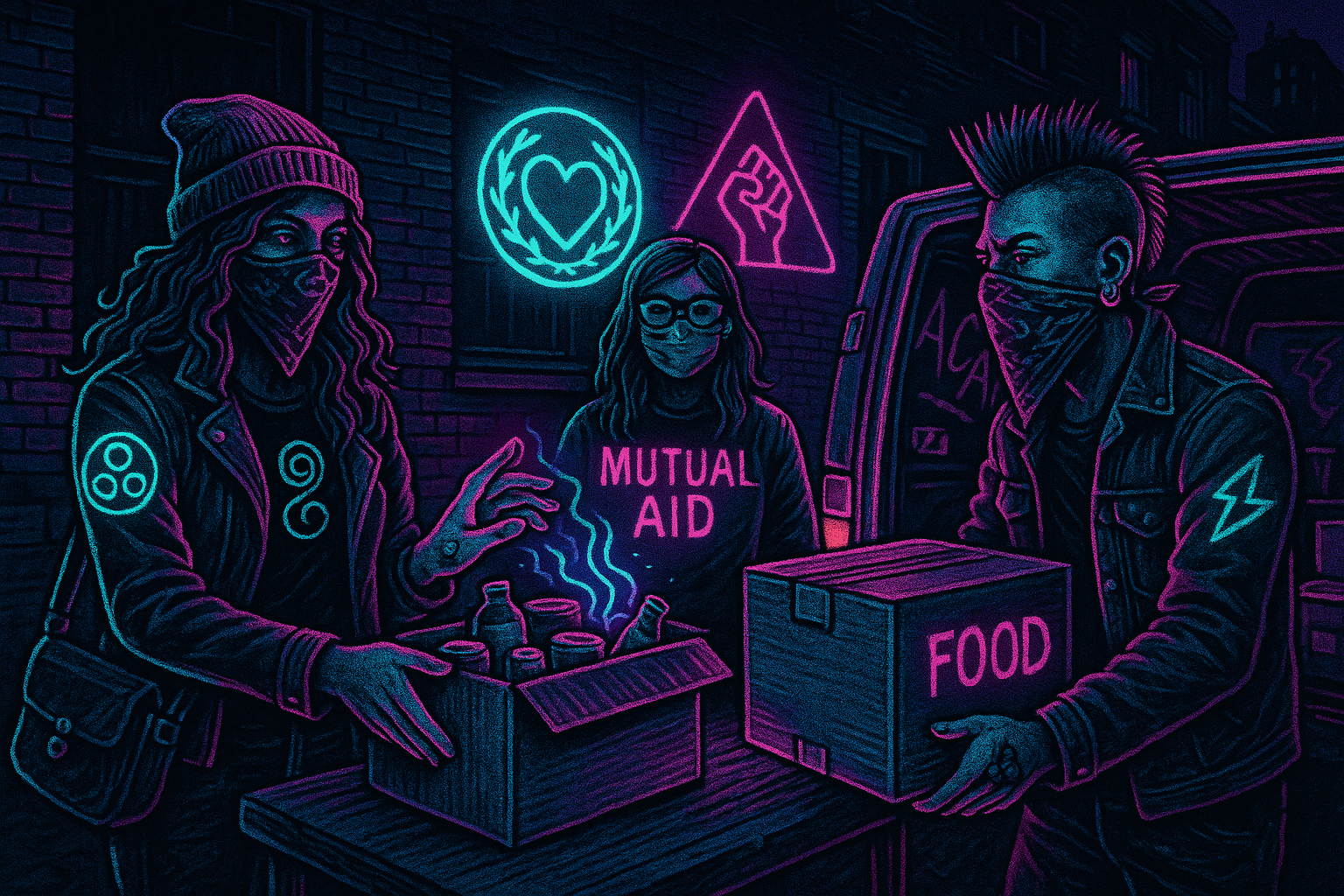
Or: You Cannot Do This Work Under Capitalism Without Material Support
Alright, let’s talk about the thing nobody wants to admit:
You cannot do deep consciousness work while you’re struggling to survive.
And under capitalism, most people are struggling to survive.
My nonna didn’t have the language “mutual aid,” but she lived it. She owned two buildings in East Boston, surrounded by extended family scattered through the neighborhood — a tiny family-tenant ecosystem, all looking out for each other. People drifted in and out of each other’s kitchens, porches, and crises. Someone lost their job? She fed them until they found work. Single mother? She was right there to manage the storm. Someone sick? She organized childcare, brought food, handled what needed handling.
The Irish filidh trained within clan structures. Material needs met collectively. You could focus on developing capacity because your community had your survival covered.
Modern Western approach: “Do your shadow work! Transform your consciousness! Just… also work three jobs to afford rent, have no safety net, and handle it all alone.”
That’s not a path. That’s a setup for failure.
Shadowcraft requires community infrastructure. Not optional. Necessary.
Let’s talk about what that actually means.
Why You Can’t Do This Work While Fighting For Survival
Maslow was right about the hierarchy.
When you’re in survival mode:
- Amygdala hyperactive (scanning for threats constantly)
- No bandwidth for integration (system focused on immediate survival)
- Can’t maintain practices (when you’re exhausted from three jobs)
- No safety for emergence (can’t risk destabilization when you’re barely holding on)
- Isolation increases (no time for community building)
Consciousness work requires:
- Enough stability to tolerate intensity
- Time for practice and integration
- Safety to destabilize temporarily
- Support when you’re in threshold crossing
- Material security so emergence doesn’t equal homelessness
You can’t develop Shadowcraft capacity while you’re terrified about rent.
You can’t navigate three-temporal processing while you’re working yourself to death.
You can’t integrate genealogical patterns while you’re in constant survival stress.
The system is designed this way. Keep people in survival mode, they can’t organize, they can’t develop consciousness, they can’t build collective power.
Mutual aid is resistance infrastructure.
What Mutual Aid Actually Is (Not Charity)
Mutual aid ≠ charity.
Charity:
- Hierarchy (helper/helped)
- One-direction flow
- Maintains power dynamics
- “I give because I have, you receive because you lack”
- Often comes with conditions/shame
Mutual aid:
- Horizontal (everyone both gives and receives)
- Reciprocal (not transactional, but mutual)
- Builds power collectively
- “We take care of each other because that’s how we survive”
- No conditions, no shame
Mutuo soccorso—mutual succor. We help each other because we’re all in this together.
Gmilut chasadim—acts of loving-kindness. But not charity—reciprocal care as community obligation.
Mutual aid is:
- Pooling resources
- Sharing skills
- Covering each other’s needs
- Building collective resilience
- Nobody does this alone
This is ancient. This is how humans survived for millennia.
Capitalism tried to make it obsolete. It isn’t.
The Mutual Aid Network For Shadowcraft Practitioners
What this looks like:
Material Support Pool
The network collectively handles:
Food security:
- Shared meal prep (bulk cooking, distribute containers)
- Community fridge/pantry
- CSA shares split among members
- Food support when someone’s in crisis/emergence
Housing stability:
- Emergency housing fund (pooled resources)
- Spare room network (short-term stays during crisis)
- Roommate matching for practitioners
- Rent support during threshold crossing
Transportation:
- Ride-sharing to gatherings/support meetings
- Car-share for those without vehicles
- Transit pass support fund
Healthcare:
- Medication fund for those without insurance
- Sliding scale/free support from practitioners in network
- Health crisis response team
- Herbalism/traditional healing resources
Technology:
- Shared devices/internet for those who need
- Tech support for those who aren’t savvy
- Communication platforms maintained collectively
Why this matters: When material needs are covered collectively, individuals can actually do the consciousness work safely.
Skill-Sharing Economy
Everyone contributes what they can, receives what they need:
Someone has:
- Accounting skills → helps others with taxes/bookkeeping
- Carpentry → helps with home repairs
- Childcare experience → covers childcare swaps
- Car → provides transport
- Tech skills → supports others’ technology needs
- Cooking skills → prepares meals
- Editing → helps with writing projects
- Legal knowledge → provides basic legal support
Not money exchange. Not barter. MUTUAL AID.
“I help you because you’re in my network. You help someone else when you can. The network takes care of everyone.”
Everyone has something to give. Everyone needs something. We just make sure it flows.
Emergency Response System
When someone’s in crisis:
24-hour response team:
- Rotating on-call schedule
- People available for immediate support
- Can be reached quickly
- Know everyone’s emergency plans
Crisis stabilization:
- Someone stays with person in crisis (not alone)
- Material needs covered (food, transport, basic care)
- Communication with their other support people
- Reality-anchoring during emergence
- Getting professional support if needed
Post-crisis support:
- Meal train (no cooking while recovering)
- Errands/practical tasks covered
- Check-ins without obligation to “be okay”
- Time and space to integrate
Why this works: Burden is distributed. No one person exhausted from supporting alone.
Time Banking For Emergence
When someone’s in threshold crossing:
The network covers:
- Their work hours (if possible—call out for them, cover shifts)
- Their responsibilities (kids, pets, household)
- Their basic needs (food delivered, laundry done, space cleaned)
- Their reality-checking (witnesses on rotation)
They get:
- Protected time to integrate
- Material security during intensity
- Support without having to ask repeatedly
- Permission to be non-functional temporarily
Later:
- They contribute back to network when they’re stable
- Support someone else’s threshold crossing
- Share what they learned
- Strengthen the network
This is how traditional cultures did it. Emergence was supported collectively. You could destabilize temporarily because the community had you.
Building Your Mutual Aid Network (Practical Steps)
Start Small (3-5 People)
Don’t try to build huge network immediately.
Start with:
- Your anam cara (if you have one)
- 2-3 other people interested in mutual aid
- People who share commitment to Shadowcraft/consciousness work
- People in similar life situation (similar needs/capacities)
Initial agreement:
- We commit to mutual support
- We share resources when able
- We cover each other during crisis
- We build this together over time
Map Resources and Needs
Everyone in network shares:
I have:
- Skills I can contribute
- Resources I can share
- Time I can offer
- Space I can provide
- Knowledge I can teach
I need:
- Support with [specific things]
- Help during [situations]
- Access to [resources]
- Coverage for [responsibilities]
Then: Match needs to resources. Find gaps. Figure out how to fill them.
Create Communication Infrastructure
Set up:
- Group chat (encrypted – Signal is good)
- Shared calendar (who’s available when)
- Resource database (who has what, who needs what)
- Emergency contact list (phone numbers, addresses, emergency plans)
- Regular meeting schedule (monthly minimum)
Why structured communication matters: In crisis, you don’t want to figure out how to reach people. Infrastructure in place BEFORE you need it.
Establish Operating Agreements
The network collectively decides:
Decision-making: How do we make decisions? (Consensus? Majority? Rotating facilitator?)
Resource pooling: What do we pool? How do we contribute? What’s the process?
Boundaries: What’s in scope? What’s out of scope? When do we involve professionals?
Conflict resolution: How do we handle disagreements? Who facilitates? What’s the process?
Membership: How do people join? How do they leave? What’s expected?
Communication norms: Response times? Check-in frequency? How do we ask for help?
Write this down. Verbal agreements drift. Documentation keeps everyone aligned.
Build Financial Pool (If Possible)
Not everyone can contribute money. That’s okay.
For those who can:
- Monthly contribution (whatever’s sustainable – $10, $20, $50)
- Pooled in shared account (transparent, multiple signers)
- Used for network needs: emergency fund, shared resources, crisis support
- Distributed according to need (not equal distribution, NEED-based)
This isn’t required. But financial pool makes material support easier.
Some networks function entirely on time/skill exchange. That works too.
Start Practicing Support (Before Crisis)
Don’t wait for emergency to test the system.
Practice with low-stakes support:
- Meal share once a month
- Help someone move
- Cover childcare for an afternoon
- Emergency drill (someone pretends crisis, network responds)
- Regular skill-shares
This builds:
- Trust that network actually functions
- Smooth processes before high-stakes situations
- Relationships that can handle intensity
- Proof that this actually works
Grow Gradually
As network stabilizes:
- Invite new people carefully (alignment with values is critical)
- Connect with other mutual aid networks
- Share resources across networks
- Build redundancy (multiple networks supporting each person)
Don’t grow too fast. Trust takes time. Sustainable beats rapid.
Prefigurative Politics (Building The World We Want)
Mutual aid isn’t just crisis support.
It’s building alternative infrastructure to capitalism.
Prefigurative politics: Creating the structures of the future world NOW, within the shell of the current system.
You’re not waiting for revolution. You’re building the new world in the cracks of the old one.
Shadowcraft + Mutual Aid = Consciousness development + Material support + Collective power
This is organizing infrastructure.
When people’s needs are met, they can:
- Organize effectively
- Develop consciousness
- Build collective capacity
- Resist exploitation
- Create alternatives
The system wants you isolated, exhausted, and focused on individual survival.
Mutual aid says: We survive together. We build together. We resist together.
Your Shadowcraft practice is political. Your mutual aid network is political. Your refusal to do this alone is political.
This is how we build power.
Why Scientists Should Care
You study individual consciousness development.
But you ignore material conditions that make development possible or impossible.
Study:
- How material security affects consciousness development outcomes
- What support structures predict successful threshold navigation
- Collective vs individual approaches to shadow work
- Mutual aid networks as consciousness development infrastructure
- How capitalism prevents consciousness development at scale
Your individualist framework misses the collective infrastructure that makes individual development possible.
Consciousness doesn’t develop in vacuum. It develops in context.
Material context matters.
Common Objections (And Responses)
“I don’t have time for mutual aid”
You don’t have time NOT to. Individual survival under capitalism is exhausting and precarious. Collective survival is more efficient and more stable.
“I don’t have resources to contribute”
Everyone has SOMETHING. Skills, time, knowledge, presence. Mutual aid is not money-only.
“What if people take advantage?”
Possible. That’s why you start small with people you trust and build gradually. Most people don’t exploit—scarcity mindset makes you think they will.
“I prefer to be self-sufficient”
Self-sufficiency is myth under capitalism. You’re already dependent on systems you don’t control. Mutual aid gives you agency in your interdependence.
“This sounds like work”
It is. But it’s work that makes OTHER work possible. Including consciousness development.
The Bottom Line
You cannot do Shadowcraft safely while struggling to survive.
Mutual aid network provides:
- Material support (food, housing, healthcare, emergency funds)
- Skill-sharing economy (everyone contributes, everyone receives)
- Emergency response (crisis support without burden on one person)
- Time banking for emergence (protected time during threshold crossing)
How to build:
- Start small (3-5 people)
- Map resources and needs
- Create communication infrastructure
- Establish operating agreements
- Build financial pool if possible
- Practice support before crisis
- Grow gradually
This is:
- Resistance infrastructure
- Prefigurative politics
- Community survival strategy
- Consciousness development support
- Collective power building
Your nonna knew this. The filidh knew this. Traditional cultures knew this.
Do this work collectively or don’t do it.
Nobody develops consciousness in isolation while fighting for survival.
Build the network. Support each other. Survive together.
Mutuo soccorso, cara. We take care of each other.
Dead Lucky | Mutual aid organizer, community infrastructure builder, collective survival advocate
Author

Discover more from X|DEADLUCKY|X
Subscribe to get the latest posts sent to your email.