

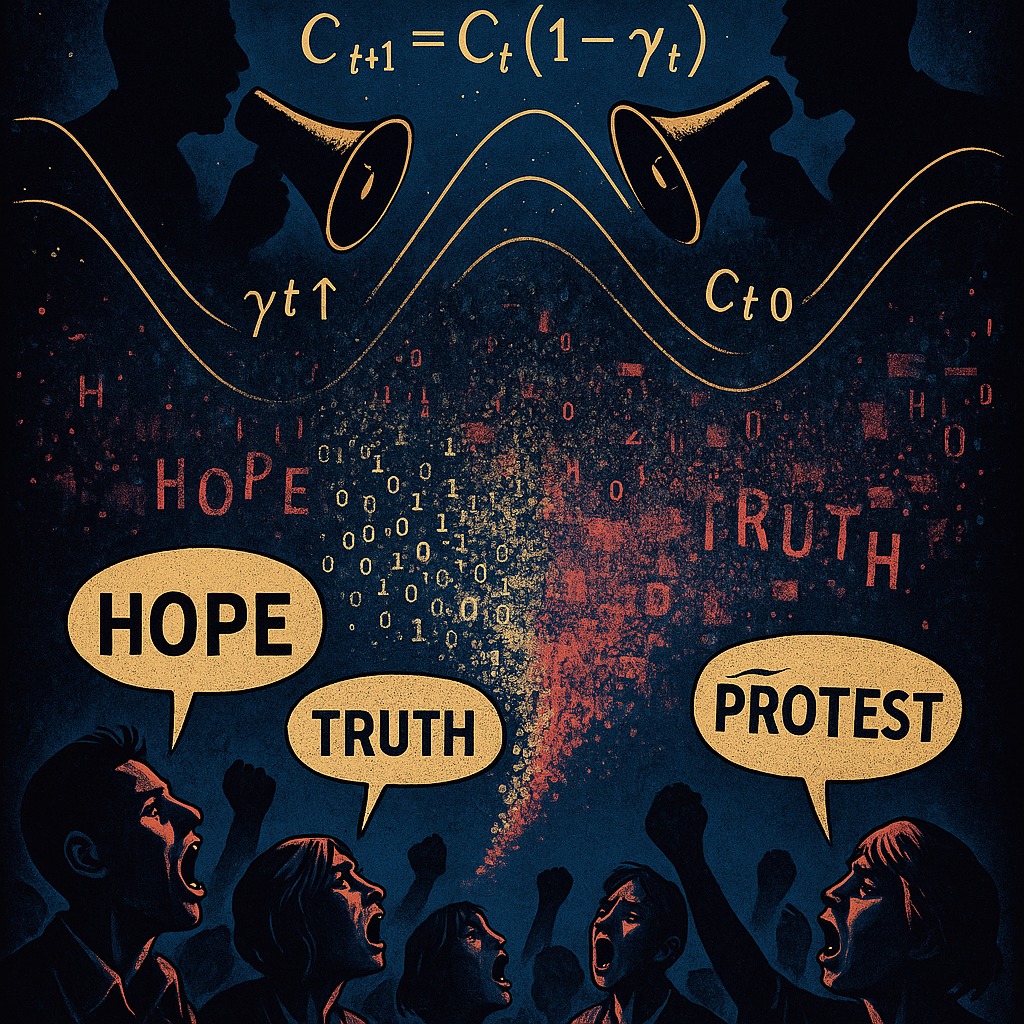

This started as a late-night rant about SNAP math and turned into a recursive harm model of poverty economics. It’s equal parts political science, thermodynamics, and moral accounting.
I’m about to tell you something you already know in your bones but refuse to admit in policy meetings: poverty is a recursive design, not a moral failure. But since structural analysis in plain language gets filed under “anecdotal” while the same argument in Greek letters gets called “rigorous,” here’s your translation.
Theoretical framework by Me™️.
Math squiggles brought to you by ChatGPT.
A Note on Method
This framework uses mathematical formalism to model structural relationships, not to make quantitative predictions. The parameters (α, γ, θ, k) represent observable mechanisms—policy capture, narrative control, semantic inversion thresholds—that shape how poverty reproduces itself recursively.
Think of it like Shannon’s use of entropy in information theory, or economists’ utility functions: the equations don’t predict specific outcomes, but they make the logic of a system explicit and testable. Each parameter can be observed qualitatively (through policy analysis, media studies, historical comparison) even if it’s not easily quantified.
This is formalized argument, not empirical modeling. The value is in forcing precision about how the system works, not in calculating how much.
1. The Basic Economic Disparity
1. The Basic Economic Disparity
- SNAP (Supplemental Nutrition Assistance Program): ~$6.67/day per recipient
- Senatorial Per Diem: $79/day for meals + $5 for incidentals
Taxpayer Contribution (on $40,000/year income):
$40 per person per year → SNAP$4000 per person per year → Corporate Welfare
Corrected:
- $30–$80/year → SNAP + TANF (I added TANF to keep it grounded in intellectual honesty.)
- $250–$350/year → Corporate Welfare (federal + state)
The average citizen still funds corporate welfare 4–10× more than direct nutritional assistance. This is on top of paying nearly all earned income back to those same corporations through consumption.
It’s worth emphasizing: SNAP recipients include working adults, children, elders, and people with disabilities — not an idle class but a working one. Two of the largest employers of SNAP recipients are Walmart and Amazon, the same corporations that receive the largest subsidies while claiming they “can’t afford” living wages.
This isn’t moral asymmetry or market failure. It’s a designed wealth inversion mechanism — an algorithm that extracts labor, recycles scarcity, and rebrands exploitation as efficiency.
2. Recursive Pattern: The Wealth Crawl
| Stage | Description | Effect |
|---|---|---|
| 1. Manufactured Scarcity | Limit social programs while amplifying corporate subsidies | Creates tension at the base of the economic pyramid |
| 2. Narrative Scapegoating | Frame poverty as moral failure | Discredits protest and suppresses systemic critique |
| 3. Credibility Collapse | Working poor are delegitimized | Prevents feedback from correcting imbalance |
| 4. Upward Wealth Crawl | Extracted resources flow upward | Capital compounds faster than support replenishes |
| 5. Semantic Inversion | Rebrand abundance as hardship | Justifies further extraction |
| 6. Repeat Cycle | Structural recursion | System self-replicates |
3. The Equations
Let:
- Wₜ refers to corporate welfare allocated per person, often through subsidies and tax breaks.
- Lₜ captures the labor output of low-income workers, which fuels upward wealth transfer.
- rₜ is the velocity of extraction — the rate at which resources are pulled upward.
- γₜ measures the effectiveness of narrative control, including propaganda and media framing.
- Cₜ reflects the credibility of the protesting class, which erodes under sustained narrative pressure.
- θ is the semantic inversion threshold — the point at which wealth claims victimhood and resets public sympathy.
Core Recursions:

Where:
- α represents the aggressiveness of policy capture — how strongly the system amplifies extraction once triggered.
- 𝕀(⋅) is the indicator function that activates when wealth disparity exceeds the semantic inversion threshold, flipping the narrative to justify further upward transfer.
4. Interpretation
- Wealth Crawling: Wₜ increases recursively at each step, compounded by labor extraction.
- Support Stagnation: Sₜ remains static — functionally flat due to inflation-adjusted erosion.
- Credibility Collapse: Propaganda reduces Cₜ to zero, disabling collective corrective mechanisms.
- Semantic Inversion: Once Wₜ ⁄ Sₜ > θ, the wealthy reframe themselves as burdened, resetting public sympathy and restarting extraction.
5. The Thermodynamic Translation
This is not just economics; it’s entropy management.
The poor operate in high-entropy systems—maximum uncertainty, minimum stored energy. The rich operate in low-entropy systems—maximum order, stored potential.
Energy (money, time, food, labor) moves uphill only through coercion and narrative control. Every dollar withheld from SNAP becomes an additional degree of order for the corporate system. Every propaganda campaign is a thermodynamic dam preventing energy backflow.
6. The Moral Equation

Where:
- k is the efficiency of narrative control — how effectively propaganda converts social support into upward wealth transfer.
- If k → 1: perfect propaganda, total extraction efficiency.
- If k → 0: the system destabilizes, risking collapse or revolution.
In short: Poverty is not a natural consequence. It’s a recursive design.

“Wealth does not trickle down. It condenses.”
Author

Discover more from X|DEADLUCKY|X
Subscribe to get the latest posts sent to your email.