

Or: How To Stop Running Programs You Didn’t Install
You know that anxiety that feels like it’s YOURS but also… not quite yours?
That hypervigilance you can’t explain?
That scarcity thinking that doesn’t match your actual life circumstances?
That rage that seems disproportionate to what’s actually happening?
Yeah. That might not be yours, love.
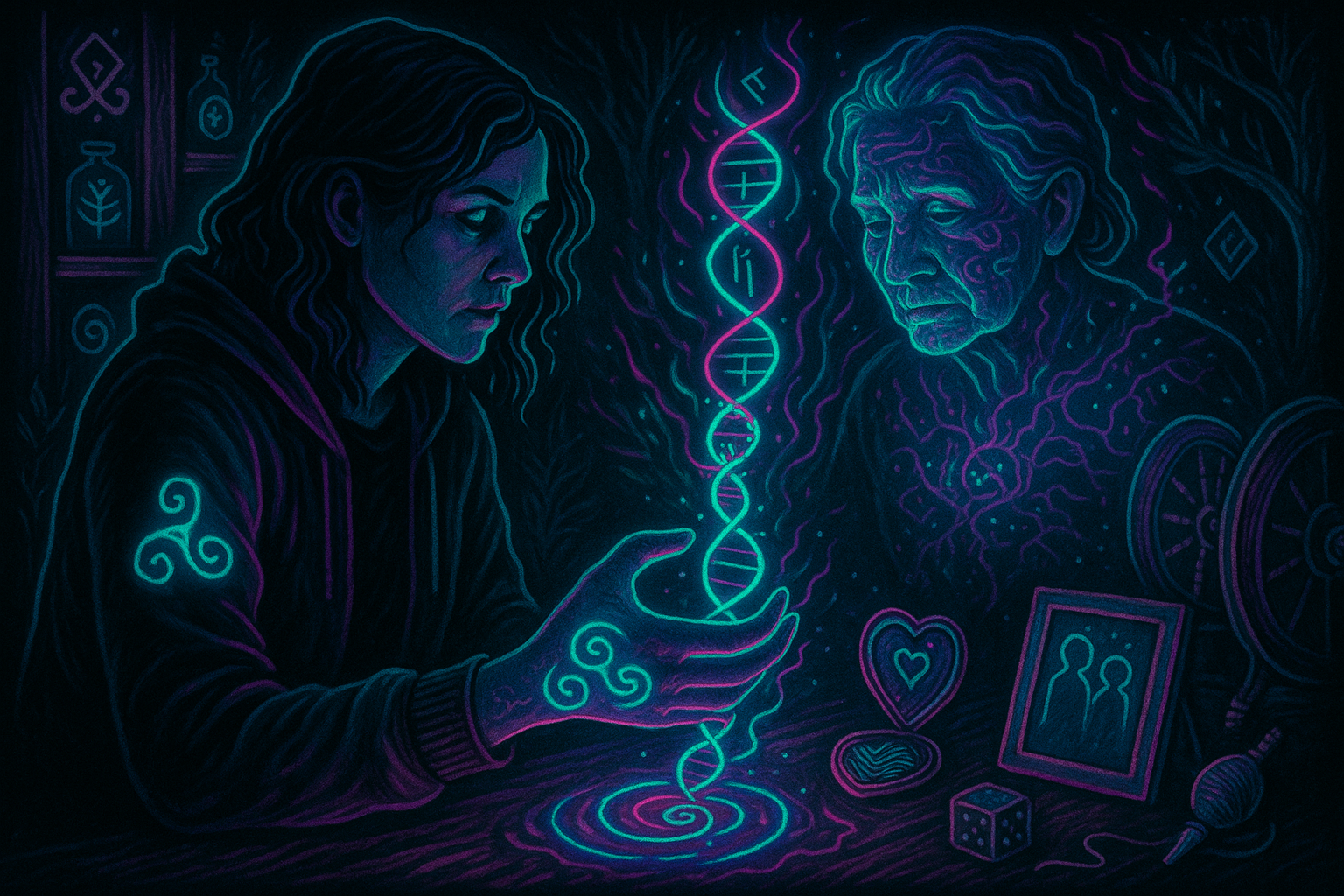
That might be your grandmother’s trauma, coded into your DNA, running in your nervous system like software you didn’t choose to install.
Welcome to epigenetic shadow work.
My nonna didn’t have the language for any of this. She only knew that losing her mother young made her fiercely overprotective — and that the same vigilance showed up in her daughter, and then in me. Three generations of the same fear pattern, coded into our cells.
She didn’t know the mechanism. But she knew the pattern was real.
Now we have the science to explain what she always knew.
And more importantly: we have methods to work with it.
The Science Part (Stay With Me)
What Epigenetics Actually Is
Your DNA doesn’t change. The sequence you were born with is what you’ve got.
But the EXPRESSION of your DNA—which genes turn on/off—that changes.
Epigenetics = the chemical tags that sit ON TOP of your DNA and control gene expression.
Think of it like this:
- DNA = the hardware
- Epigenetics = the software/operating system
- You’re born with fixed hardware but modifiable software
The mechanism:
DNA methylation: Chemical methyl groups attach to DNA, usually silencing genes
Histone modification: Proteins that DNA wraps around get tagged, changing how accessible genes are
These tags change based on:
- Environmental stress
- Trauma exposure
- Nutritional status
- Social conditions
- Emotional experience
And here’s the wild part: THEY TRANSMIT ACROSS GENERATIONS.
How Trauma Codes Into DNA
When your grandmother experienced trauma:
- Her stress response activated
- Cortisol, adrenaline, inflammatory markers flooded her system
- Her gene expression changed to adapt (hypervigilance, threat sensitivity, metabolic shifts)
- Those epigenetic changes coded into her eggs/sperm
- Which became your parent
- Which became you
The data:
Dutch Hunger Winter (1944-45): Children born to mothers who starved during pregnancy showed metabolic changes. Their GRANDCHILDREN—who never experienced famine—still showed those metabolic patterns. Two generations later. Still coded in.
Holocaust survivor studies: Children and grandchildren of survivors show altered cortisol levels, increased PTSD susceptibility, different stress responses. They inherited the biological adaptation to genocide they never experienced.
This isn’t metaphor. This isn’t “oh, they learned anxiety from watching mom.”
This is BIOLOGICAL INHERITANCE of trauma adaptations.
Your grandmother’s fear isn’t just in your family stories. It’s in your CELLS.
What You’re Actually Inheriting
Nervous System Baseline
Your grandmother lived through:
- War, famine, immigration, domestic violence, whatever her trauma was
Her nervous system adapted:
- Baseline anxiety higher (better safe than sorry)
- Threat detection more sensitive (catch danger early)
- Recovery time longer (can’t let guard down)
- Stress response stronger (survive at all costs)
You inherited:
- Same baseline anxiety (even though YOUR life is safer)
- Same threat sensitivity (you pick up danger cues she needed)
- Same slow recovery (your body thinks the threat is still present)
- Same strong stress response (your system is calibrated to HER environment, not yours)
Result: Your nervous system is running survival programs for threats that don’t exist in your actual life.
Metabolic Patterns
Your grandmother experienced:
- Food scarcity, survival conditions
Her metabolism adapted:
- Store every calorie (famine might come back)
- Slow metabolism (conserve energy)
- Efficient fat storage (survival advantage in scarcity)
You inherited:
- Same metabolic efficiency (in a world of abundance)
- Weight gain/retention patterns
- Difficulty losing weight despite “doing everything right”
Result: Your metabolism is optimized for a famine that’s not happening.
Emotional Reactivity Patterns
Your grandmother learned:
- Don’t show weakness (gets you killed)
- Don’t trust anyone (everyone’s a threat)
- Don’t feel (feelings are luxury you can’t afford)
- Don’t relax (vigilance = survival)
Her emotional regulation shifted:
- Suppression as default
- Limited emotional range
- Distrust as baseline
- Hypervigilance as normal
You inherited:
- Same suppression tendency
- Same limited range
- Same baseline distrust
- Same hypervigilance
Result: Your emotional responses are calibrated to her reality, not yours.
How To Identify What’s Inherited (The Discernment Practice)
The Questions To Ask
For each pattern/fear/response, ask:
1. Does this match my actual life experience?
Example: You’re terrified of food scarcity despite never experiencing hunger.
Probably inherited if: The fear is disproportionate to your actual experience.
2. Does this pattern appear in my family line?
Example: Your mother had the same anxiety. Her mother had it. Going back generations.
Probably inherited if: The pattern is transgenerational, not just personal.
3. Does my body KNOW this even though my mind doesn’t?
Example: Your body goes into panic around immigration/police/authority even though you’ve never had bad experiences with them.
Probably inherited if: Your somatic response knows something your conscious mind doesn’t.
4. Do I have memories/knowledge I shouldn’t have?
Example: You “remember” being in a concentration camp but you weren’t alive then.
Probably inherited if: The memories feel real but aren’t from your lifetime.
5. Does the fear/pattern serve a function that doesn’t apply anymore?
Example: Extreme food hoarding made sense during famine. Doesn’t make sense now.
Probably inherited if: The adaptation was useful in their environment, maladaptive in yours.
The Genealogical Investigation
To identify inherited patterns, you need to know what happened to them.
Research:
- Family history (ask elders, read records)
- Historical context (what was happening in their time/place)
- Immigration records, war records, economic conditions
- Family stories (the ones they tell and the ones they don’t)
Look for:
- Major traumas (war, famine, genocide, displacement)
- Ongoing stress (poverty, persecution, violence)
- Survival conditions (what they had to adapt to)
- Losses (who died, what was lost)
My genealogical research revealed:
- Sicilian side: fled violence, food insecurity, loss of land
- Irish side: famine, displacement, anti-Catholic persecution
- Jewish ancestry: pogroms, diaspora, survival against odds
No wonder I’m hypervigilant, food-anxious, and assume authority is dangerous.
That’s not MY experience. That’s THEIRS. Coded into my biology.
The Shadowcraft Approach To Epigenetic Work
Step 1: Identify The Pattern
What you’re working with:
- Anxiety, hypervigilance, scarcity thinking, rage, dissociation, whatever
Use the questions above to determine: Is this mine or inherited?
Example: “My anxiety about money feels disproportionate to my actual financial situation. My mother had this. Her mother had this. We came from poverty but I don’t live in poverty now. This feels INHERITED.”
Step 2: Map The Genealogical Source
Research what happened:
- When did this pattern start in the family line?
- What trauma/conditions created the need for this adaptation?
- What function did this serve for them?
Example: “Great-grandmother immigrated during Depression. Extreme poverty. Food insecurity. Money anxiety = survival mechanism. Made sense THEN.”
Step 3: Honor The Adaptation
This is critical:
The pattern isn’t BAD. It WORKED. It kept them alive.
Your grandmother’s hypervigilance SAVED HER.
Your grandfather’s emotional suppression GOT HIM THROUGH.
Their scarcity thinking was APPROPRIATE for their circumstances.
Don’t pathologize the adaptation. HONOR it.
“Thank you for this protection. It kept you alive. It kept the line going so I could be here. This was medicine for your time.”
Without this step, you’re fighting against the adaptation instead of updating it.
Step 4: Assess Current Relevance
Ask: “Is this adaptation still serving me in MY environment?”
Two possibilities:
Still useful: Sometimes inherited sensitivity IS appropriate for current conditions.
Example: Threat detection from persecution might actually help you recognize current fascism. Keep it. Refine it. Use it consciously.
No longer useful: The adaptation was for their environment, not yours.
Example: Food hoarding anxiety when you have consistent access to food. Time to update.
Step 5: Recontextualization (Fear→Information)
For patterns that need updating:
The anxiety/fear/pattern is INFORMATION about THEIR reality, not yours.
Translation:
- “I feel intense food anxiety” → “I’m receiving information about THEIR scarcity. MY situation is different.”
- “I feel hypervigilant” → “I’m receiving their threat detection data. Let me check: is the threat real NOW?”
- “I feel I can’t trust anyone” → “I’m receiving their survival wisdom. Let me assess: who IS trustworthy in MY context?”
You’re not dismissing the feeling. You’re translating the SOURCE.
It’s real information. Just not about your current situation.
Step 6: Somatic Updating
Your body is running old programs. You need to give it NEW information.
Nervous system practices:
- Vagal regulation (teach your body safety)
- Somatic experiencing (complete frozen responses)
- Titrated exposure (gradual updating of threat assessment)
- Co-regulation (borrow others’ calm nervous systems)
The practice:
When inherited fear activates:
- Notice: “That’s the inherited pattern”
- Acknowledge: “Thank you ancestors, I see this was protective for you”
- Reality-check: “Is this threat real NOW?”
- Body update: “I am safe now. My body can relax.”
- Stay present until nervous system integrates the new information
This takes REPETITION. Thousands of times.
You’re rewriting programs that coded over generations. It’s slow work.
Step 7: Narrative Reframing
Your family story needs updating.
Old narrative: “We’re anxious people. It’s just who we are.”
New narrative: “We carry survival adaptations from when our people faced real danger. Those adaptations served them well. I honor that. AND I get to assess what’s useful for MY life now.”
Tell the updated story:
- To yourself
- To your anam cara
- To your kids if you have them
Break the shame. Add context. Maintain agency.
Step 8: Conscious Transmission Decisions
If you’re having kids or working with younger generations:
You get to decide what you transmit.
The research shows: epigenetic changes CAN be modified through:
- Stress reduction during pregnancy
- Secure attachment (regulates infant nervous system)
- Environmental enrichment
- Nervous system regulation practices
You can’t erase the inherited patterns completely.
But you can REDUCE their transmission and give the next generation better baseline.
The Irish concept: Athghin—regeneration. Breaking the curse takes conscious work across generations.
Common Inherited Patterns & Their Likely Sources
Pattern: Hypervigilance/Constant Scanning
Likely source: War, persecution, domestic violence, dangerous environments
Function then: Catch threats early, survive danger
Current problem: Exhausting, prevents rest, sees threat where there is none
Update: “I’m receiving their threat detection. Let me assess: what’s the actual threat level HERE?”
Pattern: Food Hoarding/Scarcity Thinking
Likely source: Famine, poverty, food insecurity
Function then: Survive scarcity, prepare for famine
Current problem: Can’t enjoy abundance, anxiety despite plenty
Update: “I’m receiving information about their scarcity. I have access to food now.”
Pattern: Emotional Suppression/Numbness
Likely source: Survival conditions where feelings were luxury
Function then: Function through impossible circumstances
Current problem: Can’t access full emotional range, disconnection
Update: “They needed to suppress to survive. I’m safe enough to feel.”
Pattern: Distrust of Authority
Likely source: Persecution by government, police, institutions
Function then: Survive when authority was genuinely dangerous
Current problem: Appropriate in some contexts, overgeneralized in others
Update: “Their authority figures were dangerous. Let me assess: who’s trustworthy NOW?”
Pattern: Inability To Relax
Likely source: Constant threat, no safety, vigilance = survival
Function then: Stay alive in dangerous conditions
Current problem: Burnout, can’t rest, body always activated
Update: “They couldn’t relax safely. I’m safe enough to rest now.”
The Timeline (Because You’re Asking)
How long does epigenetic updating take?
Bad news: Longer than you want.
The research suggests:
- Initial awareness: Months to years
- Nervous system retraining: 2-5 years of consistent practice
- Full epigenetic modification: Unknown, possibly 5-10 years, possibly longer
- Transgenerational transmission changes: Multiple generations (you do the work, your kids get better baseline, their kids even better)
This is not quick fix work.
You’re rewriting biology coded over multiple generations.
Ci vuole tempo—it takes time.
Why Scientists Should Care
You’re treating anxiety/depression/PTSD as individual pathology.
When actually: A significant portion is INHERITED biological adaptation to ancestral trauma.
You’re trying to fix the person when you should be addressing the TRANSMISSION MECHANISM.
Study:
- How to identify inherited vs personal trauma
- What interventions actually modify epigenetic patterns
- How to prevent transmission to next generation
- Which practices work for which inherited patterns
- Timeline for biological updating
And maybe stop pathologizing survival adaptations that WORKED for the context they were developed in.
The anxiety isn’t “disorder.” It’s INFORMATION about what your people survived.
The Bottom Line
Epigenetic shadow work = addressing inherited trauma coded in your DNA.
What you’re inheriting:
- Nervous system baseline (anxiety, hypervigilance, stress response)
- Metabolic patterns (adaptations to scarcity)
- Emotional regulation patterns (suppression, limited range)
The practice:
- Identify the pattern (Is this mine or inherited?)
- Map genealogical source (What happened to them?)
- Honor the adaptation (It kept them alive)
- Assess current relevance (Still useful NOW?)
- Recontextualization (Fear→Information about THEIR reality)
- Somatic updating (Give body new information)
- Narrative reframing (Update family story)
- Conscious transmission (Decide what you pass on)
Timeline: Years to decades of consistent work
You’re not broken. You’re running survival programs installed by people who loved you enough to keep the line going.
Now you get to decide: What do I keep? What do I update? What do I release?
Your grandmother’s trauma lives in your cells. But so does her STRENGTH.
Dead Lucky | Epigenetic inheritor, pattern updater, transgenerational curse breaker
Author

Discover more from X|DEADLUCKY|X
Subscribe to get the latest posts sent to your email.