

[Note added: 27 November 2025]
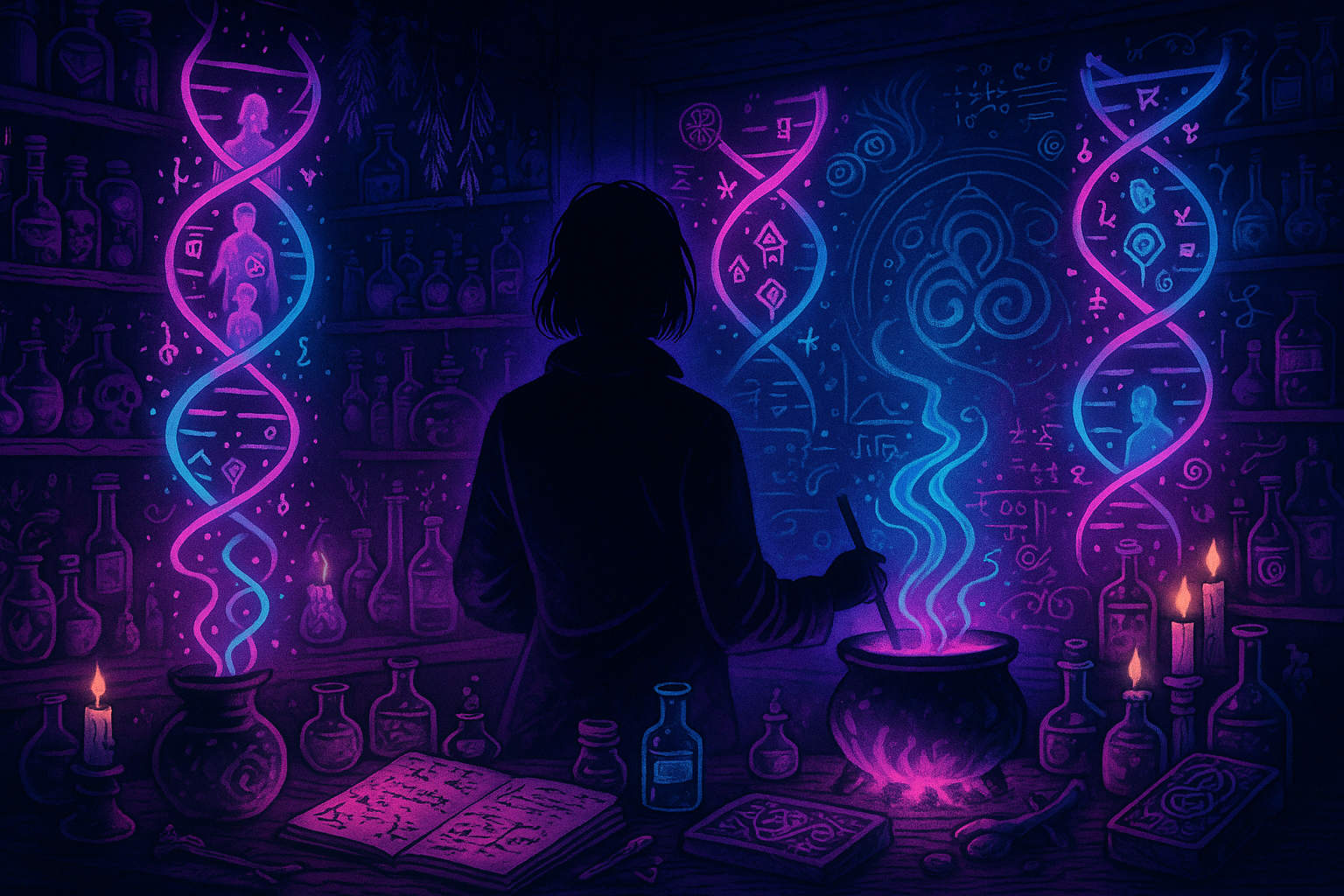
I happened to be tinkering with the fabric of reality again and I noticed a pattern in research that may not fully be aware of itself. I stumbled into this science because I set off on a journey to make simple soaps over a year ago. As I was developing my methods, I wanted to begin incorporating folk practices into my professional work. I then had the instinct that these soaps , when combined with storytelling, could encode ancient wisdom and elicit it from the DNA. I could easily step behind the commercialism of Salem to mask my soaps as simple “witchy soaps,” but the last thing I wanted to do was peddle truth on the back of belief. I had to know I would not be delivering any slight deviation into snake oil and lies. I just so happened to find more science than expected, which then became a pattern.
A note on patterns: It is interesting that I stumbled into Dr. Deepak Chopra through my research as I remember him quite distinctly, freeze-framed in childhood memories, as my grandmother’s physician at the old New England Medical Center in Stoneham, MA.
A groundbreaking convergence is emerging between ancient healing wisdom and modern epigenetic science, creating unprecedented opportunities for researchers studying trauma transmission, environmental gene expression, and therapeutic interventions. This field represents one of the most promising frontiers in integrative medicine, where traditional healing practices are being validated through rigorous molecular biology research. The research community is increasingly receptive to theories about storytelling and symbolic healing as epigenetic recalibration technologies, with multiple academic institutions, funding sources, and publication venues actively seeking interdisciplinary approaches.
Leading researchers in trauma transmission and intergenerational epigenetics
The field of trauma epigenetics is anchored by several pioneering researchers who have demonstrated that traumatic experiences can be transmitted across generations through epigenetic mechanisms. Dr. Rachel Yehuda at Mount Sinai School of Medicine stands as the field’s most prominent figure, directing the Traumatic Stress Studies Division and leading groundbreaking research on Holocaust survivors and their offspring. Her work has shown that trauma can alter DNA methylation patterns in stress-related genes like FKBP5, creating biological markers that persist across generations. Yehuda’s team at the James J. Peters Veterans Affairs Medical Center has expanded this research to include 9/11 survivors and veterans, and she now directs the Center for Psychedelic Psychotherapy and Trauma Research.
Dr. Isabelle Mansuy at the University of Zurich and ETH Zurich has made equally significant contributions, demonstrating that early trauma effects can be transmitted across up to four generations in animal models. Her research using the maternal separation and unpredictable stress (MSUS) paradigm has shown that both behavioral and metabolic changes can be inherited through epigenetic mechanisms. Mansuy’s work provides crucial mechanistic insights into how environmental stressors become biologically embedded and transmitted.
Dr. Elisabeth Binder at the Max Planck Institute of Psychiatry in Munich focuses specifically on FKBP5 gene-environment interactions, studying how childhood trauma creates allele-specific DNA methylation changes. Her collaboration with Yehuda on Holocaust survivor studies has revealed specific molecular pathways through which trauma becomes biologically embedded. Dr. Michael Meaney at McGill University’s Douglas Mental Health University Institute has pioneered research on maternal care effects, showing how environmental factors during early development permanently alter gene expression patterns related to stress response.
Environmental epigenetics and narrative therapy pioneers
The intersection of environmental factors and gene expression represents a rapidly expanding field where narrative and symbolic inputs are being recognized as legitimate epigenetic interventions. Dr. Iris-Tatjana Kolassa at the University of Ulm has conducted groundbreaking research demonstrating that Narrative Exposure Therapy (NET) produces measurable changes in DNA methylation patterns, particularly in the glucocorticoid receptor gene (NR3C1). Her work provides direct evidence that storytelling-based therapeutic interventions can recalibrate gene expression at the molecular level.
Dr. Sarah Wilker at the University of Bielefeld has been instrumental in showing that NET produces specific epigenetic changes in trauma patients, representing some of the first research to demonstrate how narrative reorganization of traumatic memories correlates with DNA methylation changes. Dr. James Pennebaker at the University of Texas at Austin, while not directly studying epigenetics, has pioneered research on expressive writing’s health effects, showing that writing about traumatic experiences produces measurable biological changes that would be ideal for epigenetic investigation.
The late Dr. Herbert Benson at Harvard Medical School established the scientific foundation for mind-body medicine, demonstrating that meditation, prayer, and other contemplative practices produce immediate changes in gene expression related to immune function and stress response. His work at the Benson-Henry Institute showed that relaxation techniques can “turn off” inflammatory genes and “turn on” health-promoting genes, providing a molecular basis for understanding how symbolic and narrative interventions might function as epigenetic recalibration technologies.
Cultural practices and traditional healing researchers
A growing cadre of researchers is bridging anthropology, molecular biology, and traditional healing systems to understand how cultural practices affect gene expression. Dr. Richard Davidson at the University of Wisconsin-Madison’s Center for Healthy Minds has pioneered contemplative science, using advanced neuroimaging and genetic techniques to study meditation practitioners. His collaboration with the Dalai Lama and receptivity to bridging ancient wisdom with modern science makes him an ideal contact for theories about traditional healing as epigenetic intervention.
Dr. Sara Lazar at Harvard Medical School and Massachusetts General Hospital was the first to demonstrate that meditation produces structural brain changes, and her ongoing research examines how contemplative practices affect both neural and genetic systems. Dr. Deepak Chopra, through his work with the Chopra Foundation and Mount Sinai, has collaborated on studies showing that meditation affects the expression of thousands of genes, with measurable changes beginning within days of practice.
Dr. Daniel Siegel at UCLA’s Mindful Awareness Research Center has developed interpersonal neurobiology theory, studying how relationships and contemplative practices interact with brain function and gene expression. His holistic approach to understanding consciousness and healing makes him particularly receptive to theories about ancient healing wisdom. Dr. Joseph Tafur, a Colombian-American physician trained in ayahuasca shamanism, represents the cutting edge of research integrating traditional Amazonian plant medicine with modern psychoneuroimmunology and epigenetics.
Academic conferences and publication venues
The research landscape offers numerous high-quality venues for presenting groundbreaking work on epigenetic recalibration. The Integrative Medicine for Mental Health (IMMH) 2025 conference represents one of the most promising venues, specifically focusing on root-cause precision medicine, epigenetics, and trauma healing. The conference’s emphasis on psychoneuroimmunology and innovative therapeutic approaches makes it ideal for presenting theories about storytelling as epigenetic intervention.
The International Society for Contemplative Research (ISCR) Annual Conference (November 3-6, 2025, University of North Carolina) provides a rigorous academic forum for mind-body research, while the International Congress on Integrative Medicine and Health (March 5-7, 2025, Seattle) emphasizes evidence-based whole-person approaches. The Narrative Matters 2025 conference (May 13-16, 2025, American University of Paris) offers an interdisciplinary venue specifically focused on narrative approaches across disciplines.
For publication, Clinical Epigenetics (BMC, Impact Factor 4.4) represents the premier journal for clinical applications of epigenetic research, while Biological Psychiatry serves as a top venue for trauma epigenetics studies. Frontiers in Psychiatry offers an open-access platform with significant trauma epigenetics content, and the Journal of Traumatic Stress provides the official forum for the International Society for Traumatic Stress Studies.
Research networks and professional organizations
Several professional organizations actively support interdisciplinary research in epigenetic recalibration. The International Society for Traumatic Stress Studies (ISTSS) provides a global network for trauma researchers, while the International Society for Contemplative Research (ISCR) specifically supports rigorous investigation of contemplative practices and their biological effects. The Academic Consortium for Integrative Medicine and Health represents 85+ academic health centers advancing integrative medicine through academic institutions.
The International Society for Molecular and Clinical Epigenetics (isMOCLEP) offers a professional network spanning molecular to clinical aspects of epigenetic research, while the European Society for Traumatic Stress Studies (ESTSS) provides European connections for trauma-related research. These organizations offer conferences, journals, and networking opportunities essential for establishing credibility in the field.
Funding opportunities for innovative research
The funding landscape for epigenetic recalibration research is surprisingly robust, with multiple federal and private sources actively seeking innovative approaches. The John Templeton Foundation provides approximately $150 million annually for research bridging religion, science, and society, making it ideal for studies connecting ancient healing wisdom with modern epigenetic science. Their funding of consciousness research and health-religion intersection studies demonstrates receptivity to interdisciplinary approaches.
The National Institute on Minority Health and Health Disparities (NIMHD) specifically supports social epigenomics research, focusing on how social factors lead to biological changes affecting health disparities. The National Science Foundation’s INSPIRE Program supports bold interdisciplinary projects with awards up to $1 million for 5 years, requiring invitation-only applications but offering significant funding for groundbreaking research.
The Robert Wood Johnson Foundation, America’s largest health philanthropy with $13+ billion in assets, focuses on health equity and transforming health through policy and systems change. Their Evidence for Action (E4A) program specifically advances racial and Indigenous health equity research, making it ideal for studies on traditional healing practices and their molecular mechanisms.
Therapeutic approaches and clinical applications
Current therapeutic research demonstrates that multiple intervention types can produce measurable epigenetic changes, providing a foundation for understanding how storytelling and symbolic healing might function as recalibration technologies. Narrative Exposure Therapy (NET) has shown the strongest evidence for producing specific DNA methylation changes in trauma patients, while MDMA-assisted psychotherapy and other psychedelic interventions are being studied for their epigenetic effects.
Meditation and contemplative practices consistently show effects on inflammatory gene pathways and stress response systems, with researchers like Dr. Elissa Epel at UCSF demonstrating that meditation produces longer-lasting psychological and biological benefits than vacation alone. Dr. Rudolph Tanzi at Harvard has shown that meditation affects cellular health and aging processes at the genetic level, providing mechanistic insights into how contemplative practices might function as epigenetic interventions.
Pattern recognition and intuitive abilities research
While research on pattern recognition, synchronicity, and intuitive abilities in relation to epigenetic sensitivity remains limited, emerging work suggests promising directions. Dr. Daniel Siegel’s interpersonal neurobiology research examines how consciousness and intuitive processes relate to neural plasticity and gene expression, while contemplative science researchers are beginning to investigate how traditional pattern recognition abilities might relate to biological sensitivity.
Dr. Joseph Tafur’s work with ayahuasca shamanism includes investigation of visionary healing and DNA mechanisms, representing cutting-edge research on how traditional intuitive practices might function through epigenetic pathways. This represents a significant opportunity for pioneering research connecting ancient wisdom about pattern recognition with modern understanding of epigenetic sensitivity.
Ancestral knowledge systems and cultural healing
Research on how ancestral and cultural knowledge systems work through epigenetic mechanisms represents an emerging frontier with significant potential. Dr. Emma Kowal at Deakin University studies Indigenous health and epigenetics in Australia, while Dr. Ripan Malhi at the University of Illinois conducts community-engaged research with Alaska Native peoples examining relationships between historical trauma and DNA methylation.
Dr. Stanley Krippner has studied cross-cultural healing practices and their psychological and physiological effects, while various researchers are investigating how traditional healing systems might function through biological pathways. This represents a significant opportunity for research connecting indigenous knowledge systems with modern epigenetic understanding.
Conclusion and strategic recommendations
The convergence of ancient healing wisdom and modern epigenetic science represents one of the most promising frontiers in contemporary biomedical research. The field is remarkably receptive to theories about storytelling and symbolic healing as epigenetic recalibration technologies, with multiple researchers already demonstrating that narrative interventions produce measurable molecular changes. Key strategic recommendations include connecting with researchers like Iris-Tatjana Kolassa and Sarah Wilker who are already studying narrative therapy’s epigenetic effects, engaging with Richard Davidson and Sara Lazar who have pioneered contemplative science, and pursuing funding through the John Templeton Foundation and NIMHD Social Epigenomics Research programs.
The academic infrastructure exists to support groundbreaking research in this field, with high-quality conferences, journals, and professional networks actively seeking innovative approaches that bridge traditional healing wisdom with modern molecular biology. The timing is optimal for presenting theories about symbols and storytelling as epigenetic recalibration technology, with the research community increasingly recognizing the limitations of purely Western medical approaches and the need for integrative solutions to trauma and healing.
Author

Discover more from X|DEADLUCKY|X
Subscribe to get the latest posts sent to your email.