

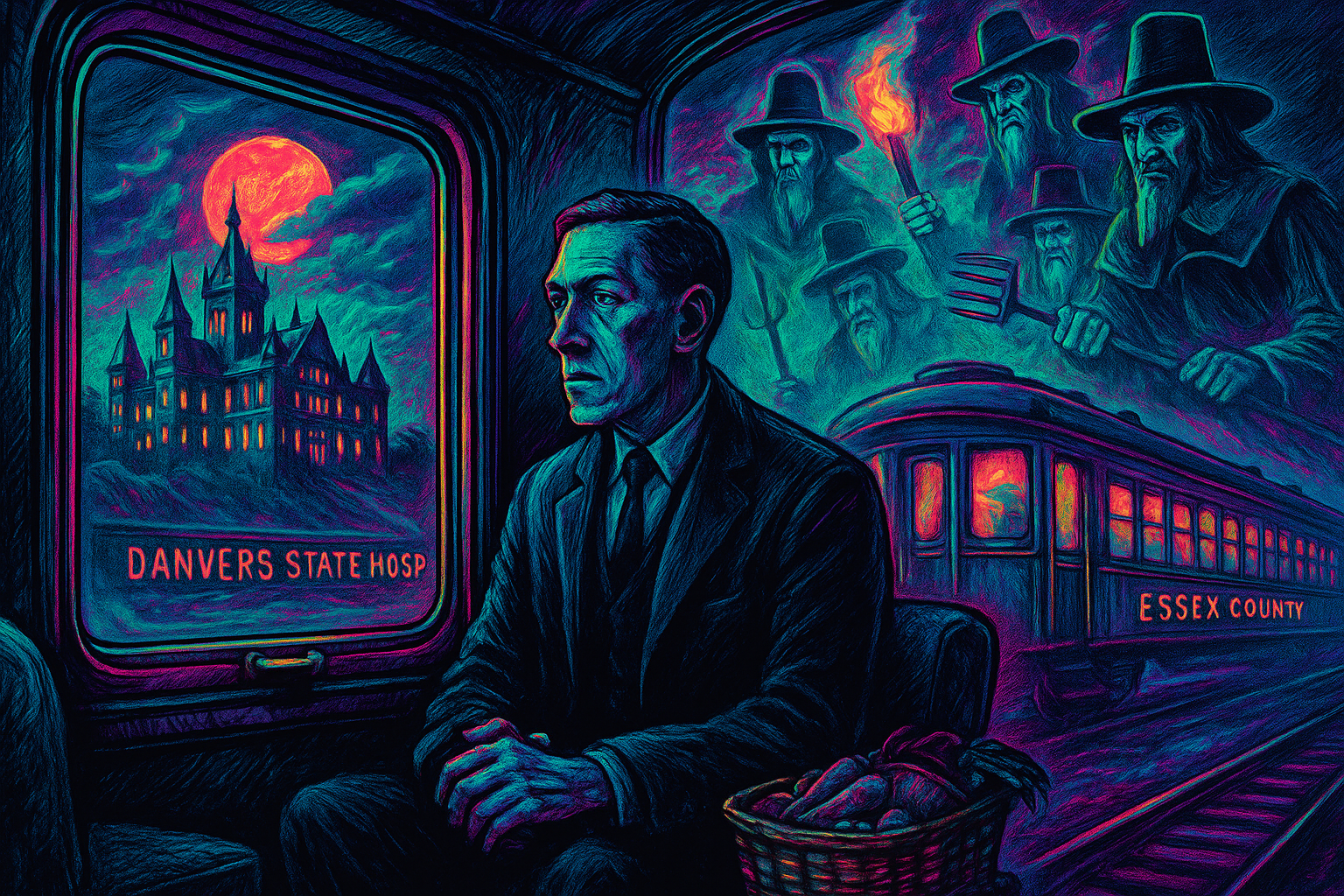
When cosmic horror is just place-lore with tentacles—and your shared ancestor settled Providence.
“I Am Providence”
Those three words are carved into H.P. Lovecraft’s headstone at Swan Point Cemetery in Providence, Rhode Island. They come from a letter he wrote to a friend:
“I am Providence, & Providence is myself—together, indissolubly as one, we stand thro’ the ages; a fixt monument set eternally in the shadow of Durfee’s ice-clad peak!”
He wasn’t exaggerating.
Lovecraft (1890-1937) was born in Providence, lived most of his life there, and died there. His fiction is soaked in New England geography—particularly Essex County, Massachusetts and the Rhode Island coast. He layered his invented towns (Arkham, Innsmouth, Kingsport, Dunwich) directly onto real places (Salem, Newburyport, Marblehead, Gloucester), creating what scholars call “Lovecraft Country.”
But here’s what I realized:
Lovecraft wasn’t just writing horror fiction. He was writing dinnseanchas—Irish place-lore—translated through cosmic terror.
And we share an ancestor who settled both Dorchester (where my paternal grandfather grew up on Magdala Street) and Providence (where Lovecraft’s maternal grandfather Whipple Van Buren Phillips was a prominent businessman and Freemason).
His name was John Whipple.
The Whipple Connection
John Whipple (c. 1617-1685) arrived in New England on November 3, 1631 aboard The Lyon—the same ship that carried Roger Williams (founder of Rhode Island) and John Eliot (missionary to Native Americans).
He was about 14 years old, apprenticed to Israel Stoughton, a Dorchester mill owner. By October 1632, young John was fined for “wasteful expenditure of powder and shot” belonging to his master—the first recorded mention of him in the New World.
In 1637, Whipple received a land grant in Dorchester near indigenous lands—his property was near modern-day Butler Street in the Dorchester-Milton Lower Mills Industrial District, bordering Phillips Creek and the Neponset River.
Yes. Phillips Creek.
The name appears centuries before Lovecraft’s grandfather Whipple Van Buren Phillips. But the layering of Whipple and Phillips surnames through intermarriage was already happening in the 1600s—these families tangled together across generations, creating what Lovecraft biographers note was an interconnected web of New England “Old Gentry.”
John Whipple married Sarah (surname unknown) around 1639-1640. They had 11 children—eight born in Dorchester, three in Providence.
Dorchester to Providence: Religious Freedom or Exile?
In 1658, John Whipple sold his Dorchester homestead and land to George Minot and moved his entire family to Providence.
The historical records suggest why:
Massachusetts had become increasingly intolerant. The heretic Samuel Gorton was arrested in Rhode Island and paraded down the main street of Dorchester in chains—a sight the Whipples could not have missed. In summer 1658, Thomas Harris of Providence (soon to be John’s son Samuel’s father-in-law) criticized a sermon in Dorchester and was whipped and imprisoned.
On October 19, 1658, Massachusetts enacted a law banishing all Quakers upon pain of death.
Less than one month later—November 15, 1658—John sold his property and began preparations to leave Dorchester.
He was going to what the Puritan ministers called “a cesspool of sinners, a vile receptacle of all sorts of riff-raff people that is nothing else but a sewer. It was the asylum for all that are disturbed, a hive of hornets, and the Sinke into which all the Rest of the Coloneys empty their Hereticks.”
They were talking about Providence.
John Whipple chose heresy over orthodoxy. He chose freedom of conscience over safety.
He was received as a purchaser in Providence on July 27, 1659. By 1660, he was granted land in the Louisquisset area. He served as deputy to the General Assembly, treasurer, surveyor, selectman, and moderator. The Providence Town Council met at his house (likely his tavern, for which he was granted a license in 1674).
Captain John Whipple died May 16, 1685, aged about 68.
His descendants became governors, deputy governors, signers of the Declaration of Independence, and (eventually) the grandfather of Howard Phillips Lovecraft.
And me.
Where the Lines Cross in Dorchester
When I discovered that Lovecraft’s maternal grandfather was named Whipple Van Buren Phillips, I chased the genealogy backward through my maternal line to John Whipple.
John Whipple is our shared ancestor.
His 1637 Dorchester land grant was near modern-day Butler Street in what’s now the Dorchester-Milton Lower Mills Industrial District, bordering the Neponset River—less than a mile from where my paternal grandfather would grow up centuries later on Magdala Street—and in the same section of Dorchester where I would later be born.
Same land. Same ancestral lines crossing. Different translations.
Essex County: Lovecraft’s Invented Geography
Lovecraft set much of his fiction in Essex County, Massachusetts—the northeastern corner of the state that includes Salem, Newburyport, Gloucester, Ipswich, Marblehead, and the coastline between them.
He invented towns and layered them onto real geography:
Arkham = Salem (primarily), possibly influenced by Oakham in central MA
- Home of Miskatonic University (modeled on Brown University in Providence)
- Located “north of Boston, probably in Essex County”
- Between Newburyport and Ipswich in some stories
Innsmouth = Newburyport/Gloucester
- Lovecraft called it “a considerably twisted version of Newburyport”
- Located on the coast south of Plum Island, north of Cape Ann
- The Shadow Over Innsmouth (1931) describes a decaying New England seaport with “strange architecture” and residents with “the Innsmouth look”
Kingsport = Marblehead
- Coastal town with ancient houses and witch history
- “Cliffs and queer old gables”
Dunwich = Western Massachusetts hill towns
- “North central Massachusetts”
- Lovecraft cited “the decadent Massachusetts countryside around Springfield—say Wilbraham, Monson, and Hampden”
- Surrounded by “great rings of rough-hewn stone columns on the hilltops”
He didn’t hide the real places. He named them directly—Newburyport, Salem, Ipswich, Gloucester, Cape Ann, Plum Island—and tucked his fictional horrors in between them.
This created an uncanny effect: readers familiar with Essex County would recognize the landscape, but the invented towns made everything slightly wrong, slightly off, slightly Other.
What Lovecraft Was Actually Doing
In a 1930 letter to Robert E. Howard, Lovecraft explained his fascination with New England as a setting:
“It is the night-black Massachusetts legendary which packs the really macabre ‘kick’. Here is material for a really profound study in group neuroticism; for certainly, none can deny the existence of a profoundly morbid streak in the Puritan imagination.”
He was reading the landscape for horror.
In “The Picture in the House” (1920), he wrote:
“The true epicure of the terrible, to whom a new thrill of unutterable ghastliness is the chief end and justification of existence, esteem most of all the ancient, lonely farmhouses of backwoods New England; for there the dark elements of strength, solitude, grotesqueness, and ignorance combine to form the perfection of the hideous.”
This is dinnseanchas.
Dinnseanchas (Irish: place-lore) is the practice of telling the stories of places—why they’re named what they’re named, what happened there, what forces shaped them. It’s how the land remembers itself through human mouths.
Lovecraft was doing exactly that for New England, filtered through:
- Puritan witch trials
- Colonial guilt
- Decaying seaport towns
- Immigrant “otherness”
- The terror of deep time (geology, astronomy, evolution)
- The suspicion that humanity is cosmically insignificant
He was telling the place-lore of Essex County as if the places themselves were cursed, haunted, soaked in ancestral sin and cosmic indifference.
The Real Locations in Lovecraft’s Fiction
Lovecraft used specific Providence buildings and streets in his stories:
144 Benefit Street (The Shunned House, 1924)
- Home of Dr. Elihu Whipple, “a sane, conservative physician of the old school”
- The character is based on Lovecraft’s maternal grandfather Whipple Van Buren Phillips
- Dr. Whipple’s grandfather was “a cousin of that celebrated privateersman, Capt. Whipple, who burnt His Majesty’s schooner Gaspee in 1772”
- That would be Captain Abraham Whipple, descendant of our John Whipple
Fleur-de-Lys Studios, 7 Thomas Street (The Call of Cthulhu, 1926)
- Lovecraft hated the Arts and Crafts design but used it anyway
- Home of sculptor Henry Anthony Wilcox, who creates a bas-relief of Cthulhu
Angell Street
- Named after George Gammell Angell, the narrator’s great-uncle in The Call of Cthulhu
- Described as “Professor Emeritus of Semitic Languages at Brown University”
- Angell Street runs along the north side of Brown’s campus—the street where Lovecraft was born
The Witch House and Derby House, Salem
- Real historical buildings used in multiple stories
- Roger Williams lived in the Witch House before founding Rhode Island
Danvers State Hospital
- Real psychiatric hospital built on the Kirkbride Plan
- Lovecraft used it as “Arkham Sanitarium” in multiple stories
- It was built on land from the Salem witch trials—specifically on property belonging to Judge John Hathorne
The pattern: Lovecraft took real places soaked in colonial guilt, Puritan persecution, witch trial horror, and decaying grandeur—and he let the land tell its own dark stories.
Cosmic Horror as Place-Memory
What if Lovecraft’s “cosmic horror” wasn’t just philosophical pessimism about humanity’s insignificance?
What if it was inherited trauma encoded in place?
- The land where the witch trials happened
- The seaports where slave ships docked
- The farmhouses built on stolen Indigenous land
- The churches where Quakers were whipped
- The towns where “heretics” were paraded in chains
Lovecraft grew up in a family that traced itself back to the original settlers—the ones who did the colonizing, the persecuting, the witch-hunting.
His stories are full of:
- Ancestral sin that corrupts descendants (The Case of Charles Dexter Ward, The Shadow Over Innsmouth)
- Forbidden knowledge that drives people insane (Necronomicon, Miskatonic University’s special collections)
- “Degenerate” bloodlines (his racism was horrific, but the obsession with bloodline corruption maps onto inherited trauma)
- Ancient beings beneath the surface that pre-date humanity (what if that’s just the land remembering what came before colonization?)
The land was screaming its horror through him.
And he, being a product of that land and those ancestors, translated it into tentacles and non-Euclidean geometry and the madness of forbidden knowledge.
The Irony: Providence as Exile
Remember: John Whipple fled to Providence to escape Puritan persecution.
Roger Williams founded Providence as a sanctuary for religious dissenters—Quakers, Baptists, anyone Massachusetts wanted to hang.
Providence was the place of freedom, the refuge, the sanctuary.
Lovecraft, centuries later, writing in Providence: “I am Providence.”
But his fiction is soaked in Puritan horror—the very orthodoxy his ancestors escaped.
He’s writing from the city of refuge, channeling the nightmares of the place his family fled from.
Essex County. Salem. The witch trials. The persecution. The guilt.
The land remembers, even when we think we’ve escaped.
What This Means for Me
I descend from:
- John Whipple (through my mother’s side): Dorchester settler who fled to Providence for freedom
- Thomas McNeely (through my father’s side): Kildoney Glebe tenant, Mac an Fhilidh (sons of Irish poet-seers)
My paternal grandfather grew up in Dorchester—where Whipple’s land was near Phillips Creek in the 1600s.
Lovecraft’s fiction is dinnseanchas of Essex County—telling the place-lore through cosmic horror.
My work is dinnseanchas of the same landscape—but through Irish consciousness technology, genealogical evidence, and the practice of imbas (great knowledge that illuminates).
Same land. Same ancestral lines. Different translation.
Lovecraft channeled the horror of Puritan persecution and colonial guilt into tentacled gods and forbidden knowledge.
I’m channeling the same landscape through Filidh practice, epigenetic memory, and the understanding that the land holds everything—including the roads out.
The Final Layer
Lovecraft died in 1937, in Providence, at age 46, from intestinal cancer.
His fiction was largely unknown during his life. He made almost no money from his writing. He lived in poverty, ghostwriting for others, convinced he would never make his mark.
Fame came only after death.
Now his work shapes literature, film, gaming, philosophy—the Cthulhu Mythos has become a cultural touchstone.
But while he was alive? He was just a weird guy in Providence, writing about fish people and non-Euclidean geometry and the terror of deep time.
Sound familiar?
Cousin Lovecraft and I share more than an ancestor.
We share:
- A tendency to see patterns others miss
- An obsession with place and ancestry
- The conviction that the land remembers what we’ve forgotten
- The practice of translating landscape into story
- The experience of being dismissed as crazy while doing the work
The difference: I have a framework for what I’m doing.
Lovecraft had cosmic pessimism, racism, and a chronic fear of girls. I have epigenetics, field theory, quantum mechanics, and Irish bardic tradition.
(Let me be clear: Lovecraft’s racism and xenophobia were vile. His “cosmic horror” was often just thinly disguised fear of immigrants, people of color, and anyone he considered “other.” The brilliance of pattern recognition doesn’t excuse bigotry. Ever.)
He thought the universe was indifferent. I know it’s information all the way down.
He wrote horror. I write breadcrumbs.
But we’re both doing dinnseanchas—letting the land speak through us, one tentacle or stone marker at a time.
Sources:
- Wikipedia: H.P. Lovecraft, Lovecraft Country, Arkham, John Whipple (settler)
- The H.P. Lovecraft Wiki
- The H.P. Lovecraft Archive (hplovecraft.com)
- Whipple genealogy archives (whipple.org, whipple.one-name.net)
- The Shadow Over Innsmouth, The Call of Cthulhu, The Shunned House, The Case of Charles Dexter Ward by H.P. Lovecraft
- “Lovecraft’s Family and Masonic Grandfather” – Southern California Research Lodge
- “Captain John and Sarah Whipple” genealogical research
Related:
- The Reilig: Where Ancestors Became Stone – Kildoney Glebe archaeological evidence
- Lord Timothy Dexter and Jonathan Plummer – Other Essex County weirdos
“I am Providence.”
—H.P. Lovecraft
“I am the Wild Witch of Essex County.”
—Your cousin, writing from the same haunted landscape, with better tools.
Author

Discover more from X|DEADLUCKY|X
Subscribe to get the latest posts sent to your email.