

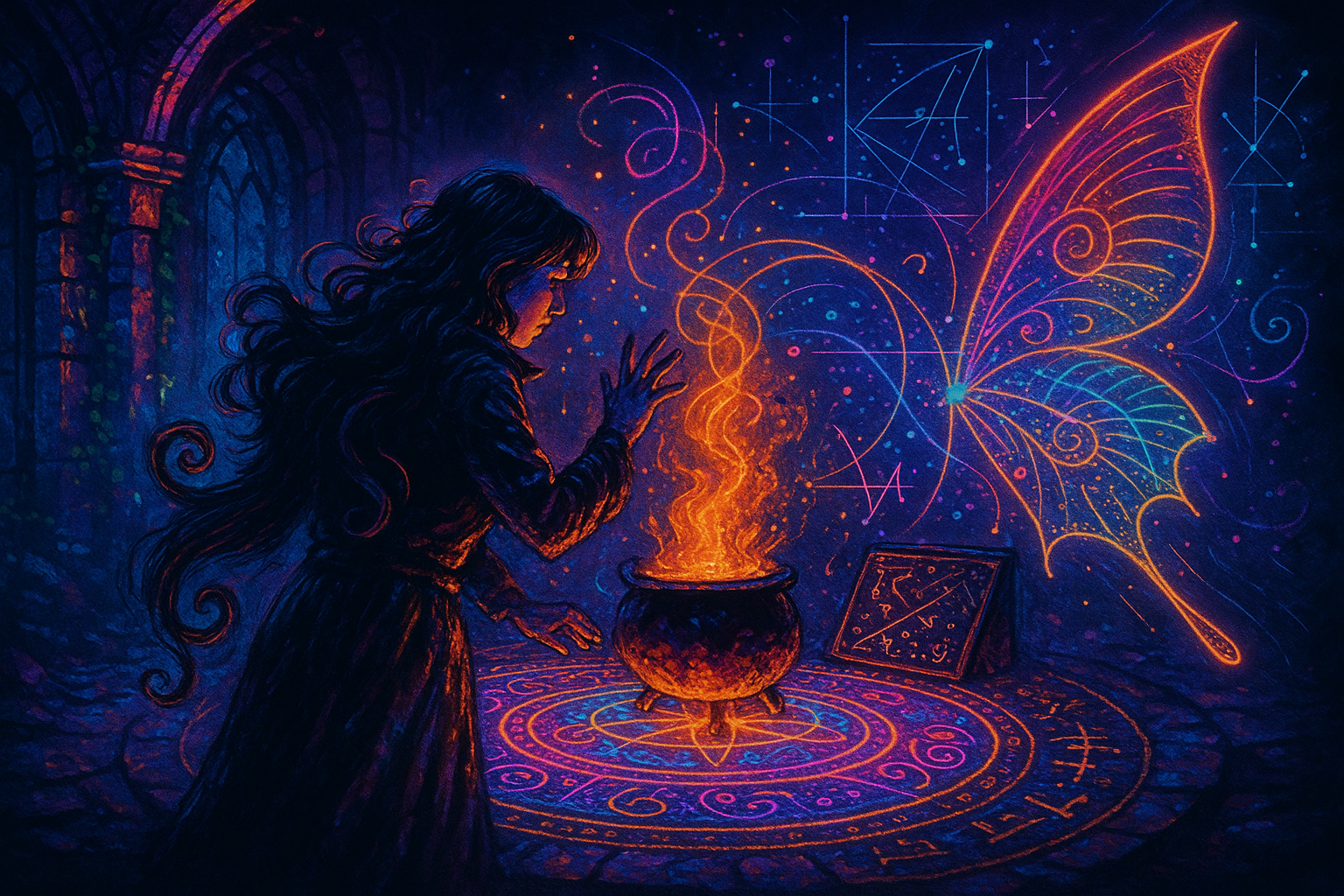
Chaos Magic is Just Chaos Theory: How Rituals Ride the Butterfly Effect
Small inputs, massive outcomes—welcome to nonlinear spellcraft.
The Central Claim
Chaos magic isn’t irrational—it’s mathematics. Every ritual, every spell, every whispered intention plays on the same rules that govern weather systems, stock markets, and planetary motion. Complex systems amplify small nudges into world‑shifting cascades. The ancients didn’t need Lorenz equations to know this—they tested it with incense, circles, and chants.
1. The Butterfly Effect: Intention as Initial Condition
- Physics side: Sensitive dependence on initial conditions means that tiny changes at the start create radically different outcomes. A butterfly flaps in Brazil, a tornado hits Texas.
- Tradition side: A whispered spell, a flicker of ritual fire, a single decision at a crossroads—tiny inputs in consciousness fields that ripple outward.
- Translation: Intentional acts seem small but alter the trajectory of whole systems.
“A spell is just a butterfly wing disguised as ritual.”
2. Strange Attractors: Why Patterns Repeat
- Physics side: Chaotic systems don’t spin into total randomness—they orbit around structures called strange attractors. These are the hidden geometries that shape behavior over time.
- Tradition side: Ancestral cycles, karmic loops, recurring life themes—ancients mapped these repeating attractors in myth, ritual calendars, and sacred law.
- Translation: “Karma” isn’t mystical—it’s a system’s tendency to orbit the same attractor until you shift the conditions.
“Your life theme isn’t fate—it’s an attractor begging to be hacked.”
3. Emergence: Order from Apparent Chaos
- Physics side: Complex systems self‑organize. Out of local randomness, global order emerges—flocks, weather bands, neural networks.
- Tradition side: Ritual circles, communal rites, festivals—chaotic individuals coalesce into harmony through shared symbols and actions.
- Translation: Magic is structured emergence. The rules look simple, but the patterns they generate are sophisticated.
“Spells don’t force order—they coax it to emerge.”
4. Why It Matters
- Chaos magic is not superstition—it’s applied complexity science.
- Ritual works because systems are nonlinear: small shifts echo large.
- Cycles repeat because attractors exist. Communities form coherence through emergence.
“The difference between chaos math and chaos magic is only vocabulary.”
Takeaway
When you light the candle, draw the circle, or whisper the charm, you’re not suspending disbelief—you’re inserting a butterfly wing into a nonlinear system. Physics calls it sensitive dependence. The ancients called it magic.
Author

Discover more from X|DEADLUCKY|X
Subscribe to get the latest posts sent to your email.