

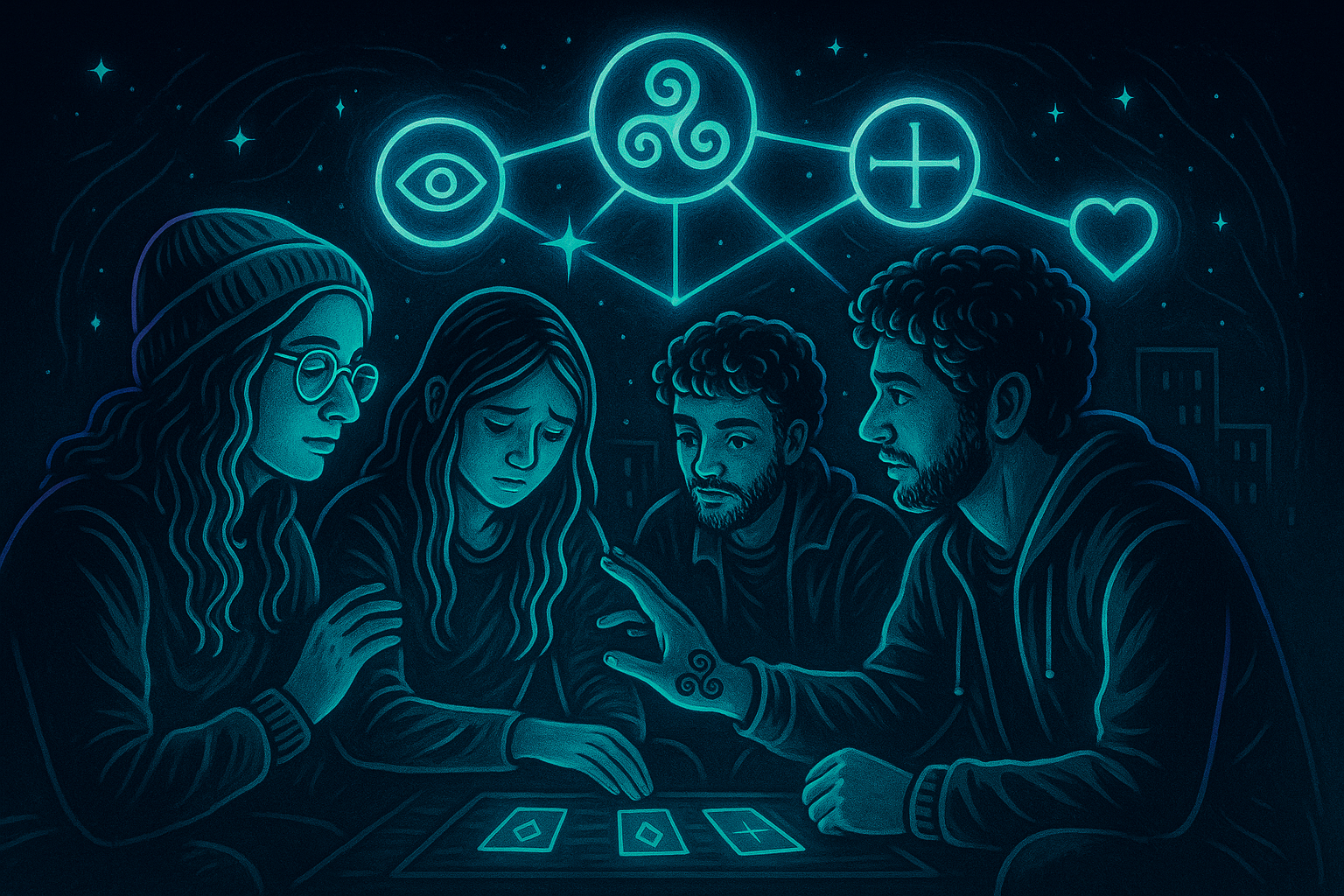
Or: Humans Heal In Relationships, Not In Offices
Okay, let’s talk about healing.
Real healing. Not clinical healing.
Clinical model says: Individual goes to professional, professional fixes individual, individual returns to life “cured.”
Reality says: Humans heal in relationships. In being witnessed. In community. In reciprocal care that doesn’t pathologize.
My gramma never went to therapy. She healed through: her sisters (50 years of Sunday coffee and witnessing), her children (daily check-ins), priests of her parish (who understood souls, not just sins), the women at church (who’d survived similar struggles), even her husband, and the network of people who SAW her.
She wasn’t broken. She was witnessed.
The Irish filidh healed through: their anam cara (soul friend), their clan (community infrastructure), their elders (pattern-holders), and the web of relationships that held them.
They weren’t diagnosed. They were held.
Whatever one’s opinion might be on the clinical model, we all know it’s just INSUFFICIENT.
And for most people, it’s inaccessible, unaffordable, or retraumatizing.
So let’s talk about building the witness network you actually need.
Why The Clinical Model Is Insufficient (Even When It Works)
Clinical model assumptions:
- Healing happens in 50-minute sessions
- One expert, one patient
- Professional knows better than person experiencing
- Individual pathology requires individual treatment
- Cure = return to “normal” functioning
- Relationship ends when treatment ends
Reality:
- Healing happens in ongoing relationships, not scheduled sessions
- Wisdom is distributed (professional has training, person has lived experience, both know things)
- Power differential often replicates trauma dynamics
- Most “pathology” is normal response to abnormal circumstances
- Goal isn’t “normal,” it’s INTEGRATED AND FUNCTIONAL
- Healing relationships often become lifelong
What clinical model DOES provide:
- Specific expertise (diagnosis, medication, crisis intervention)
- Structured space (consistent time, clear boundaries)
- Trained skills (therapeutic modalities, safety protocols)
- Legal protection (mandatory reporting, documentation)
Keep these when you need them, if they are part of your toolkit. Crisis stabilization, medication assessment, specific trauma processing—professionals have value. Various tools have their time and their place. As with healing, the toolbox should evolve over time.
But: Most healing happens OUTSIDE that room. In your relationships. In being witnessed. In community.
Build infrastructure that reflects this reality.
The Witness Network Model (What Actually Heals)
Healing happens through:
- Being SEEN without judgment
- Reality-checking without dismissal
- Pattern-tracking over time
- Honest feedback without shame
- Support without fixing
- Witnessing without pathologizing
- Reciprocal care (not one-way help)
- Long-term commitment (years, not sessions)
This requires NETWORK, not just one relationship.
Why network:
- No single person can hold everything
- Different people see different patterns
- Redundancy = resilience (if one unavailable, others remain)
- Distributes burden (supporting someone in crisis is intense)
- Multiple perspectives = better reality-checking
- Community healing > individual healing
Your witness network includes:
- Anam cara (primary witness partnership—1-2 people)
- Close witnesses (3-5 people who know you deeply)
- Community circle (10-20 people, varying closeness)
- Specialized support (professionals when needed, peer groups, specific skills)
All operating together as web of care.
The Core: Your Anam Cara
This is your PRIMARY witnessing relationship.
- Peer partnership (no hierarchy)
- Weekly minimum check-ins
- Reality-checking permission
- Pattern-tracking over years
- Mutual work (both people growing)
- Deep trust built slowly
Without anam cara, rest of network is fragile.
This is foundation. Build it first.
Close Witnesses (Your Inner Circle)
3-5 people who:
- Know your major patterns
- Can reality-check you
- Have seen you through intensity
- Won’t abandon when things get hard
- Can tolerate hard truths
- Have their own support (not using you as only anchor)
These are NOT:
- Your only support (anam cara is that)
- Casual friends
- People you just met
- People in crisis themselves
These ARE:
- Trusted longtime friends
- Family members who get it (if you have them)
- Fellow practitioners you’ve worked with extensively
- People who’ve witnessed your emergence before
What they provide:
- Different perspectives than anam cara (more reality-checking)
- Backup support (if anam cara unavailable)
- Community feeling (you’re not isolated to one relationship)
- Different strengths (each person sees different things)
Frequency: Monthly minimum check-ins, more during intensity
Structure: Less formal than anam cara, but still INTENTIONAL. Not just “hanging out.”
You explicitly ask them: “Will you be part of my witness network? Here’s what that means…”
Community Circle (Wider Network)
10-20 people at varying levels of closeness:
Inner ring: Anam cara + close witnesses (already covered)
Middle ring:
- Peer support group members
- Mutual aid network folks
- Practice community (if you have one)
- Extended family/chosen family
- Colleagues who understand the work
Outer ring:
- Acquaintances who share values
- Community members you trust somewhat
- Online connections (carefully chosen)
- Professional relationships (therapists, doctors, etc.)
What community circle provides:
- Social infrastructure
- Distributed support
- Different perspectives
- Collective wisdom
- Material resources
- Sense of belonging
Not everyone in circle knows everything about you. Different relationships serve different purposes.
But together: They create web of connection that holds you.
Specialized Support (When You Need Specific Expertise)
Professionals (Use Them, Don’t Depend On Them Alone)
When professionals are useful:
- Safety logistics: When a situation requires immediate outside coordination to prevent harm.
- Medical rule-outs: When you need a physical evaluation to confirm what isn’t causing an experience.
- Targeted trauma techniques: When you want someone trained in specific methods for untangling old patterns.
- Interpretive clarity: When you need a second set of eyes on what’s happening, without making it your identity.
- Medication shifts: When transitioning on/off meds or adjusting doses and you want someone who understands the physiology involved.
- Systems paperwork: When institutions require documentation or signatures to navigate bureaucracy.
How to use professionals:
- As PART of network, not whole network
- For specific expertise, not total care
- As consultants, not saviors
- With clear role (what they provide, what they don’t)
Questions to ask professionals:
- Do they support your other relationships or discourage them?
- Do they respect your autonomy or position themselves as expert authority?
- Do they understand limits of clinical model?
- Can they work WITH your witnesses, not instead of them?
Red flags:
- Claims you don’t need anyone else
- Discourages outside support
- Pathologizes normal responses
- Won’t collaborate with your network
Good professionals:
- Encourage your witness network
- Respect your other relationships
- See themselves as part of team
- Support your autonomy
Peer Support (People Who’ve Been Through It)
Why peer support matters:
- Shared experience (they GET it)
- No pathologizing (it’s NORMAL to them)
- Practical strategies (tried/tested by people who lived it)
- Mutual learning (everyone both teacher and student)
- Reduces isolation (you’re not alone in this)
Peer support is often MORE effective than professional support for:
- Ongoing integration
- Normalization of experience
- Practical coping strategies
- Long-term community
- Mutual aid
Look for peer groups in your area. If none exist: START ONE.
See “Resources: Peer Support Group Networks & Frameworks” for an extensive list of established peer support networks & frameworks.
Specialists (Specific Skills)
Different people for different needs:
- Somatic practitioner (body-based work)
- Herbalist (plant medicine support)
- Acupuncturist (nervous system regulation)
- Nutritionist (especially trauma-informed)
- Bodyworker (massage, rolfing, etc.)
These support your BODY’S healing, which supports consciousness work.
Not therapy. Not pathology treatment. Body support.
How To Build Your Network (Practical Steps)
Step 1: Map Current Relationships
Who do you already have?
Write it out:
- Who knows you deeply?
- Who can reality-check you?
- Who’s witnessed you through hard times?
- Who can tolerate intensity?
- Who has their own support?
This is your starting point.
Step 2: Identify Gaps
What’s missing?
- Need anam cara? (primary witness partner)
- Need more close witnesses? (inner circle too small)
- Need community? (too isolated)
- Need peer support? (no one with shared experience)
- Need professional for specific thing? (crisis support, medication, trauma processing)
Don’t try to fill all gaps at once. Prioritize.
Step 3: Build Slowly (Trust Takes Time)
Don’t:
- Rush intimacy
- Dump everything on new person immediately
- Expect instant deep trust
- Make someone your only support
Do:
- Start with low-stakes sharing
- Test trustworthiness gradually
- Notice who shows up consistently
- Build multiple relationships simultaneously (not all eggs in one basket)
Timeline: Months to years to build real trust.
Piano piano si va lontano—slowly slowly, one goes far.
Step 4: Make Agreements Explicit
Don’t assume people know what you need.
Ask directly: “I’m building a witness network for my consciousness work. Would you be interested in being part of that? Here’s what I mean…”
Then: Explain what you’re asking for (reality-checking, pattern-tracking, emergency support, whatever)
Get explicit agreement: “Yes, I’m willing to do that” or “No, I can’t, but here’s what I CAN do”
Clear agreements prevent resentment and confusion.
Step 5: Maintain The Relationships (Infrastructure Requires Upkeep)
Networks don’t maintain themselves.
Regular maintenance:
- Anam cara: weekly minimum
- Close witnesses: monthly minimum
- Community circle: showing up consistently
- Peer groups: regular attendance
- Check-ins when you’re doing okay (not just crisis contact)
Reciprocity:
- You’re not just receiving support
- You witness others too
- You contribute to network
- Mutual aid, not one-way help
If relationship is all take, no give: THAT’S NOT MUTUAL.
Step 6: Protect Against Exploitation
Not everyone deserves access to you.
Watch for:
- People who only show up when they need something
- People who drain more than they support
- People who can’t respect boundaries
- People who make everything about them
- People who use vulnerability against you
It’s okay to:
- Limit contact
- End relationships that harm
- Protect your energy
- Have boundaries
A mentsh on a sod iz vi a fish on vaser—a person without secrets is like a fish without water.
Some privacy is healthy. Not everyone needs to know everything.
What To Do When Network Isn’t Enough (Emergency Protocol)
Sometimes witness network can’t handle what’s happening.
Signs you need more support:
- Multiple people in network are scared
- Reality-testing failing despite network input
- Safety compromised
- Network is overwhelmed/burned out
- You’re not stabilizing with current support
Then:
- Bring in professionals (crisis team, therapist, hospital if necessary)
- Expand network (additional peer support, more witnesses)
- Increase structure (more frequent check-ins, more people involved)
- Accept help level you need (even if that’s intensive)
Your network should recognize when more support is needed and HELP YOU ACCESS IT.
Not gatekeeping. Not “we can handle everything.” Appropriate assessment.
The Network Over Time (What It Becomes)
Year 1: Building, figuring out who’s who, establishing agreements
Years 2-5: Deepening trust, testing through intensity, solidifying structure
Years 5-10: Network becomes family, relationships solidify, collective wisdom builds
Years 10+: Intergenerational web, network supports networks, collective healing visible
My gramma and her network: 50+ years. That’s the goal.
Not therapy that ends. Lifelong web of care.
Why Scientists Should Care
You study individual healing in clinical contexts.
But most healing happens in community, through relationships, outside professional settings.
Study:
- Peer support effectiveness vs professional therapy
- Long-term outcomes: network-supported vs clinically-treated
- What makes witness networks effective?
- How does reciprocal care differ from professional help?
- What infrastructure supports community healing?
Your clinical bias blinds you to where healing actually happens.
Look at the relationships, not just the treatment.
The Bottom Line
Humans heal in relationships, not offices.
Witness network includes:
- Anam cara (primary witness partner)
- Close witnesses (3-5 inner circle)
- Community circle (10-20 wider network)
- Specialized support (professionals, peers, specialists as needed)
Build it by:
- Mapping current relationships
- Identifying gaps
- Building slowly (trust takes time)
- Making agreements explicit
- Maintaining relationships
- Protecting against exploitation
Clinical model is part of network, not substitute for network.
Use professionals for specific expertise. Build community for ongoing healing.
Your nonna knew this. Build the web.
Non si fa da soli, cara. We don’t do this alone.
Dead Lucky | Witness network builder, community healer, relationship infrastructure advocate
Author

Discover more from X|DEADLUCKY|X
Subscribe to get the latest posts sent to your email.